The Great Kitchen Panic: Will a Spoon Actually Detonate Your Microwave?
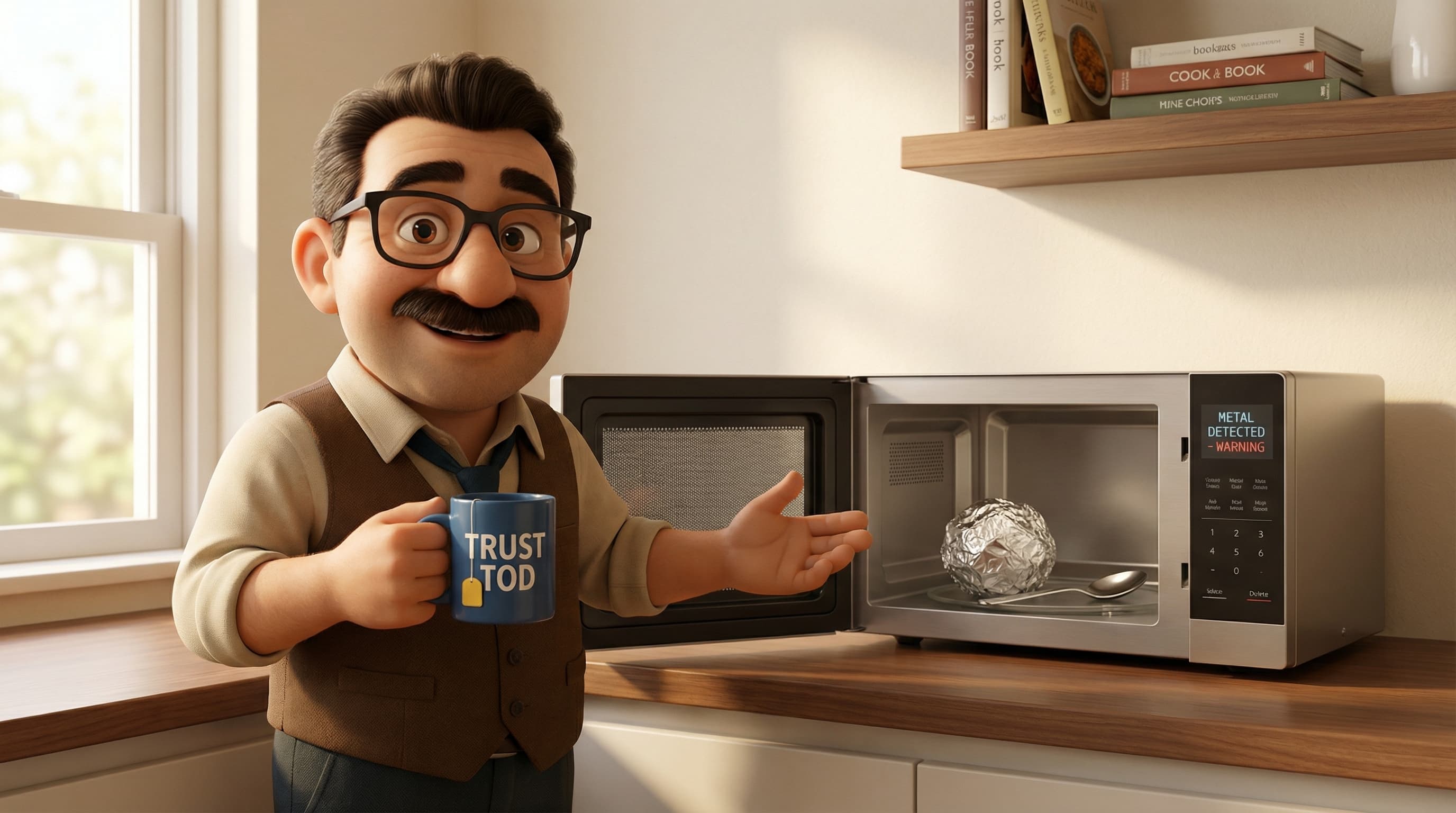
We’ve all been there, haven’t we? It’s a rainy Tuesday evening, you’re absolutely shattered after a long day, and you’ve just popped a mug of tea into the microwave because—let’s be honest—you forgot about it twenty minutes ago. You hit the ‘Start’ button, watch the little plate spin for three seconds, and then your heart stops.
The spoon.
You left the teaspoon in the mug.
If you’re anything like me, you probably performed a frantic, Olympic-level sprint across the kitchen, diving for the ‘Stop’ button as if you were defusing a bomb in an action movie. We’ve been conditioned to believe that a single stray piece of aluminium foil or a forgotten piece of cutlery will instantly turn our trusty appliance into a smouldering crater, possibly taking the kitchen cabinets with it.
But here’s the thing: while nobody wants a kitchen disaster, the reality of what happens when metal meets microwaves is a fair bit more nuanced—and arguably more interesting—than the explosive rumours suggest. So, grab yourself a fresh cuppa (spoon removed, just for peace of mind), and let’s have a natter about what actually goes on inside that magic box.
The Myth: A Recipe for Disaster?
The belief is universal. I’ve chatted with folks from Edinburgh to Exeter, and the consensus is always the same: Metal + Microwave = KABOOM. It’s one of those golden rules of adulthood, right up there with "separate your whites from your colours" and "never mention the price of your house at a dinner party."
The fear isn’t just about breaking the machine; it’s about safety. The visual we have in our heads is catastrophic—shattered glass, fireballs, and a frantic call to the fire brigade. This myth persists because, frankly, the visual evidence can be terrifying. If you have ever accidentally microwaved a piece of gold-rimmed china or a scrunched-up foil wrapper, you’ve likely seen the indoor firework display that ensues. Those sparks (or ‘arcing,’ as the boffins call it) look incredibly dangerous. To the untrained eye, that light show looks exactly like the prelude to a detonation.
But is the machine actually plotting to blow up? Or is it just throwing a bit of a tantrum?
A Trip Down Memory Lane: Why We Believe It
To understand why we’re all so terrified of metal in the microwave, we need to hop in a time machine back to the 1970s. Picture the scene: brown wallpaper, orange carpets, and the very first microwave ovens hitting the British high street.
Back then, these appliances weren’t the £50 bargains you can pick up at the supermarket today. They were serious financial investments, often costing the equivalent of a month’s wages. And the technology, while revolutionary, was a bit more sensitive than modern kit.
The heart of a microwave is a component called the magnetron. It’s a vacuum tube that generates the actual microwaves. In those early models, the magnetron was notoriously sensitive to something called "feedback." If the energy waves it sent out weren’t absorbed by a nice jacket potato or a bowl of soup, they would bounce around and reflect back into the magnetron. This return-to-sender energy could overheat the component and destroy it permanently.
Manufacturers were terrified of liability and warranty claims. If a customer put a metal tray in, and the waves reflected off it straight back into the magnetron, the machine was toast. So, they slapped absolute, zero-tolerance warnings on everything: "NO METAL COOKWARE."
It made sense at the time. A damaged magnetron meant the unit was essentially scrap. But as the decades rolled on, the technology improved, yet the terrifying warnings remained etched in our collective consciousness.
The Truth: It’s Not the Material, It’s the Shape
Right, let’s get into the nitty-gritty. How does this actually work?
Microwaves cook food by emitting electromagnetic waves that excite water, fat, and sugar molecules. When these molecules wiggle, they create heat. Now, when these waves hit materials, three things can happen:
- Absorption: Food soaks up the waves and gets hot.
- Transmission: Glass, plastic, and ceramics let the waves pass straight through (mostly).
- Reflection: Metal acts like a mirror. It bounces the waves away.
Here is the headline news: Metal itself does not explode. The microwave oven is, literally, a metal box. If metal were incompatible with microwaves, the machine itself wouldn't exist! The mesh screen on the door? Metal. The interior walls? Metal.
The real culprit isn't the material; it’s the geometry.
The "Pointy" Problem (Arcing)
Imagine a crowd of people (electrons) on a dance floor. On a large, smooth surface—like a metal spoon or the walls of the oven—the electrons can move around freely and happily. They spread out, and the waves just bounce off. A spoon left in a mug of tea is actually usually fine (though I wouldn't recommend making a habit of it) because the curves are smooth.
However, if you put in something with sharp edges, points, or thin creases—like a fork or a piece of crumpled aluminium foil—you have a problem. The electrons get pushed by the microwaves and congregate at the sharp tips, like a crowd panicking to get through a narrow door. This creates a massive build-up of electrical charge at the tip.
When that charge gets too high, it has to go somewhere. It jumps through the air to the nearest conductive surface. Zap! That is a plasma arc. That’s the spark you see. It creates ozone, a loud pop, and can scorch the inside of your oven. But—and this is key—it is not an explosion.
The Grape Paradox
Here’s a fun fact to trot out at the pub: A metal spoon is often safer in a microwave than a grape. Yes, really. If you cut a grape almost in half, leaving a tiny bridge of skin connecting the two pieces, it acts as a perfect antenna for the waves. It will spark violently and create plasma, far more aggressively than most cutlery. Yet nobody goes around screaming "Don't put fruit in the microwave!"
Modern Reality: Can I Use Foil?
You might have noticed that if you buy a cheeky ready-meal curry or a pie from the shops, it often comes in a foil container. Wait, foil? In the microwave?
Yes! Modern guidance has shifted. In the UK, it is generally accepted that you can microwave these shallow foil trays, provided you follow the rules:
- The 3cm Rule: The tray should be shallow (under 3cm).
- The 25% Rule: The foil shouldn't cover more than a quarter of the cooking space surface.
- No Touching: The metal must absolutely never touch the walls of the microwave. If it touches the wall, you complete a circuit, and you will get arcing.
Modern magnetrons are also much tougher than their 1970s ancestors. They have better shielding and can tolerate a bit of reflected energy without immediately giving up the ghost. Furthermore, many of us now have "Combi" ovens that use metal racks for grilling. Notice how those racks are always round with no sharp corners? That’s engineering at work.
The Verdict: Tod’s Takeaway
So, will putting metal in the microwave make it explode like a bomb? No. That is a myth born of 1970s manufacturer anxiety and visual misunderstandings.
However, can it cause a fire, damage your expensive appliance, or ruin your dinner? Absolutely.
Arcing can melt the plastic interior of your oven, scorch the paintwork, or ignite the paper towel you wrapped your sandwich in. Plus, if you put a big thick metal lid over your food, the waves will just bounce off, and your Shepherd's Pie will be stone cold in the middle. Not exactly the culinary triumph we’re aiming for.
Here is my advice:
- Forks are forbidden: The tines are perfect lightning rods for sparks. Keep them out.
- Spoons are risky but not deadly: If you accidentally leave a spoon in your coffee, don’t panic. Just take it out and carry on. It likely won't spark, but it does shield the liquid from heating properly.
- Smooth foil is fine (with care): Shielding the wing tips of a chicken with smooth foil to stop them burning? perfectly clever tech use. Just don't crinkle it!
Technology is there to serve us, not scare us. Understanding how it works takes the fear away and stops the kitchen panic attacks. If you’re looking for a microwave that’s smart enough to handle your culinary adventures (or perhaps one that’s just really easy to clean after a soup explosion), pop over to my place.
Visit tod.ai today to find the perfect appliances tailored to your needs. I’ll pop the kettle on!
Related reading: