The Sunday Afternoon Panic
Picture the scene. It’s a rainy Sunday afternoon, you’ve got a proper brew in hand, and you’re comfortably sunk into the sofa. You’re halfway through a brilliant YouTube documentary when the dreaded notification pops up: Battery Level 5%.
So, you lean over, plug your charging cable in, and settle back down to finish your video. Suddenly, a well-meaning relative—let's call her Auntie Jean—gasps.
"You shouldn't use it while it's plugged in!" she warns, looking genuinely concerned. "You'll fry the battery! It's going to ruin the phone, or worse, blow up!"
Sound familiar? If you live in the UK, chances are you’ve either received this warning or given it yourself. The belief that using a smartphone whilst it’s charging will permanently damage the battery is one of the most enduring, widespread tech myths of our time.
But is Auntie Jean right? Should we be treating our plugged-in phones like delicate, radioactive artifacts?
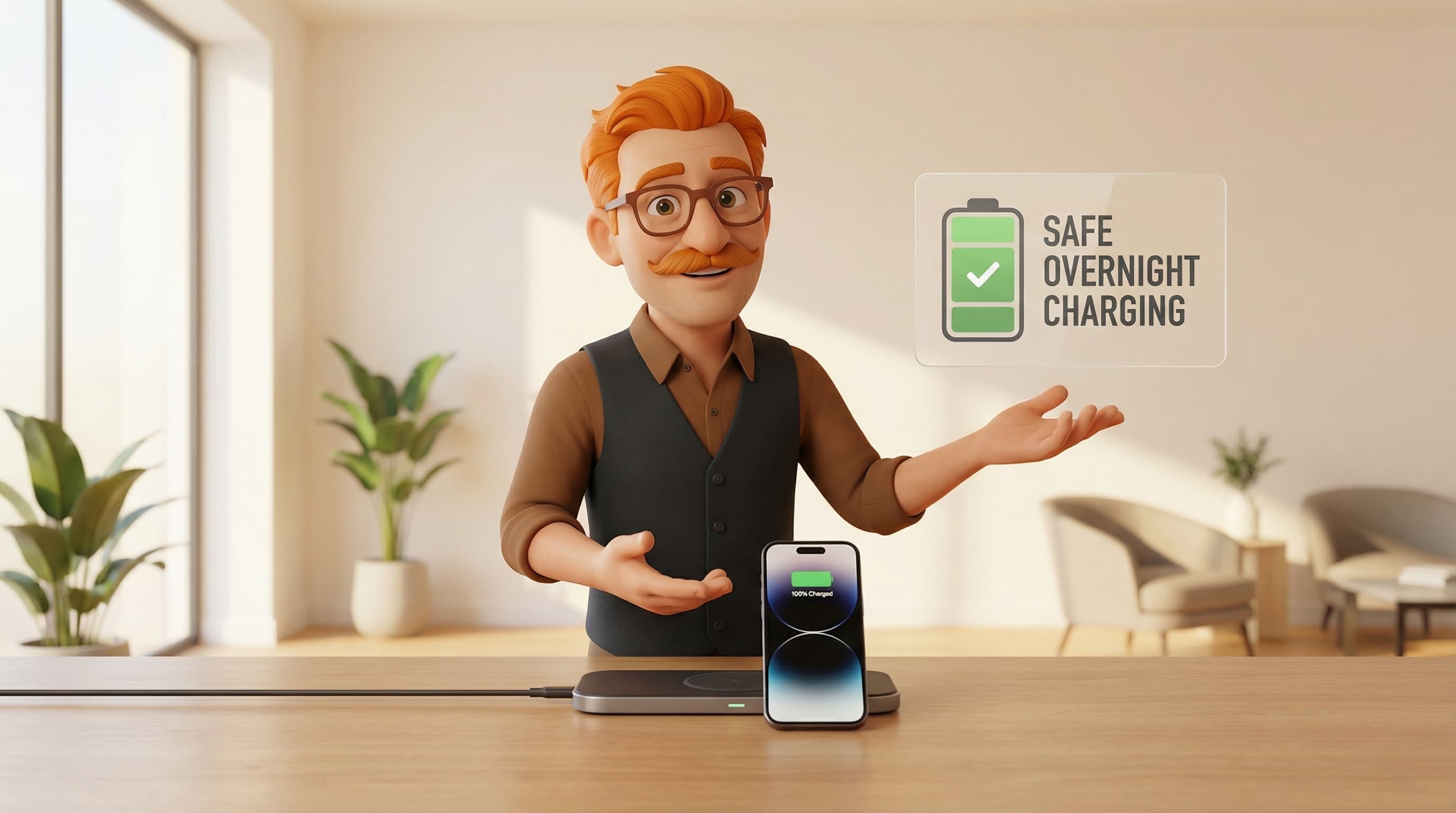
Grab another cuppa, because today we’re going to dive into the surprisingly fascinating world of mobile phone batteries. I’m Tod, your resident tech enthusiast, and I’m here to separate the facts from the fiction.
The Myth: A Battery Doing Two Jobs at Once
Let's look at why this myth makes so much logical sense to the average person. On the surface, it feels like basic physics.
People imagine the battery as a sort of bucket. If you’re charging the phone, you’re pouring water into the bucket. If you’re using the phone, you’re scooping water out. If you do both at the same time, the poor bucket gets confused, works twice as hard, creates massive internal pressure, and eventually breaks.
Many folks also worry about "overcharging". The fear is that if you use the phone while it's at 100% and still plugged into the mains, the electricity will just keep forcing its way into a full battery until it degrades the chemical components.
It sounds completely reasonable, doesn't it? And here is the plot twist that catches a lot of people out: twenty years ago, Auntie Jean was absolutely spot on.
The History: When the Myth Was Actually True
To understand where this belief comes from, we need to take a nostalgic trip down the high street to the late 1990s and early 2000s. Ah, the era of the legendary Nokia "brick" phones. Blimey, those things could survive a nuclear blast, but their batteries were a completely different story.
Before Lithium-ion (Li-ion) became the industry standard, our mobile phones ran on Nickel-Cadmium (NiCd) or Nickel-Metal Hydride (NiMH) batteries. These older chemistries were notoriously finicky. They were highly sensitive to temperature changes and erratic charging behaviours.
Crucially, early mobile phones lacked the sophisticated smart chips that modern devices possess. If you heavily used a vintage mobile while it was charging, the battery genuinely was trying to absorb energy and output energy simultaneously. This caused significant internal resistance, leading to extreme heat. And heat, my friends, is battery poison. It rapidly degraded the lifespan of those older cells.
But it gets a bit darker than just a flat battery. In the early 2010s, as we transitioned to the first generation of smartphones, the UK market was flooded with cheap, uncertified third-party chargers sold in discount shops and market stalls for a couple of quid.
These dodgy chargers lacked basic safety transformers and electrical isolation components. If you played a demanding game on an early smartphone whilst using a sub-standard £2 charger, the combined heat from the phone’s processor and the unregulated, messy voltage from the plug genuinely could destroy the battery. In some high-profile cases reported by UK Fire and Rescue Services, it even caused electrical fires or electrocutions.
So, the myth was born from a place of absolute truth. But technology didn't stand still.
The Truth: Meet Your Phone’s Tiny Traffic Warden
Fast forward to today. The smartphone in your pocket or on your desk is a marvel of modern engineering. It exclusively uses a Lithium-ion (Li-ion) or Lithium-polymer (Li-Po) battery. But the real game-changer isn't just the battery chemistry; it’s the microscopic bouncer guarding the door.
Modern smartphones contain something called a Power Management Integrated Circuit (PMIC). Think of the PMIC as a highly efficient, incredibly strict tiny traffic warden living inside your phone, dedicated entirely to managing electricity.
When you use a modern smartphone whilst it is plugged into the wall, the PMIC steps in. It is smart enough to route power from the mains directly to the phone's processor and screen, bypassing the battery completely. The remaining electrical current is then safely, gently fed into the battery to charge it up.
Let me say that again, because it's the absolute crux of debunking this myth: When you use a modern plugged-in phone, the phone runs off the mains electricity, not the battery.
Your battery isn't getting confused or doing two jobs at once. It's just sitting there quietly soaking up the leftover juice while the wall socket does all the heavy lifting for your YouTube video or WhatsApp scrolling.
What about overcharging? Once again, the PMIC has your back. It is physically impossible to overcharge a modern smartphone. Once a Li-ion battery hits 100%, the PMIC shuts the gate. It stops accepting current into the battery entirely. The phone simply continues to run off the mains electricity until you unplug it.
The Real Enemy: It’s Not the Cable, It’s the Heat
So, using your phone while it's charging is perfectly safe. Case closed, right?
Well, mostly. There is one massive caveat we need to talk about, and it brings us back to the number one enemy of lithium-based batteries: Extreme Heat.
According to Battery University (an incredibly thorough educational platform run by Cadex Electronics), keeping a Li-ion battery at elevated temperatures—specifically anything above 35°C—will permanently reduce its overall capacity over time.
Using your phone for light tasks while it's charging—like sending a text, reading the news, or scrolling through Instagram—generates negligible heat. Your battery couldn't care less.
However, if you decide to perform highly intensive processing tasks while the phone is plugged in, you might run into trouble. Imagine you are playing a graphically demanding 3D mobile game, rendering a 4K video, or using your phone for GPS navigation on your car dashboard while the summer sun beats down on it.
The processor is working at maximum capacity, generating a lot of heat. Simultaneously, the battery is fast-charging, which also generates heat. Combine the two, and the internal temperature of the phone can skyrocket past that safe 35°C mark.
To combat this, modern phones use "Thermal Throttling". If the PMIC detects that things are getting a bit too toasty, it will automatically slow down the charging rate to a trickle, or stop charging altogether. It will also slow down your processor, making your game stutter, just to cool things down.
But if you routinely force your phone into these hot states day after day, you will degrade the battery's lifespan faster over the course of a couple of years.
So, the scientific consensus is clear: Using the phone doesn't damage the battery; the heat generated by certain types of heavy usage might.
Dodging the Common Battery Traps
Before we wrap up, let's quickly squash a few other persistent battery myths that tend to float around British pubs and family group chats.
"You need to drain the battery to 0% before charging to prevent battery memory." Absolute rubbish, I'm afraid! This is a massive hangover from the NiCd battery days. Lithium-ion batteries do not suffer from the "memory effect". In fact, deliberately draining a Li-ion battery to 0% causes deep chemical stress. Modern batteries are happiest when they are kept between 20% and 80%. They love little top-ups throughout the day.
"Fast charging damages the battery instantly." Not true. Fast chargers are incredibly clever. They operate in two phases. They rapidly pump power into the empty battery up to around 70% or 80%—which is when the battery can absorb it without overheating. Then, they severely slow down the charging speed for the remaining 20% to prevent thermal damage. It’s perfectly safe.
"Any charger is fine, the phone will sort it out." Please, do not fall for this. While your phone's PMIC is smart, cheap, unbranded chargers are inherently dangerous. UK Trading Standards and Electrical Safety First frequently seize counterfeit chargers, finding they lack basic electrical insulation. A faulty £3 plug can send 230V of mains electricity straight past the PMIC, frying your device and potentially causing a fatal electric shock. Always, always use certified gear.
The Verdict: Tod’s Top Charging Tips
Let's get one thing straight: you can absolutely use your phone whilst it's charging. You don't need to stare at a blank screen waiting for the percentage to tick up.
To keep your smartphone battery happy, healthy, and lasting for years, just follow these simple rules of thumb:
- Keep it light: Feel free to watch videos, text, and browse while plugged in. But if you want to play heavy 3D games or edit video, it’s best to let the phone charge first, unplug it, and then play.
- Look for the hallmark of safety: Always use cables and charging bricks provided by the manufacturer. If you buy third-party accessories, ensure they are MFi certified (for Apple devices) or carry legitimate UKCA or CE safety marks. Don't risk a house fire to save a fiver.
- Let it breathe: Never charge your phone under a pillow or tucked into your bedding. The heat has nowhere to escape, and UK Fire and Rescue Services constantly warn about the severe fire risks this poses. Keep it on a hard, flat surface like a bedside table.
- Turn on the smarts: Make sure features like Apple's "Optimised Battery Charging" or Android's "Adaptive Charging" are turned on in your settings. They learn your routine and manage overnight charging brilliantly to prevent cell stress.
And there you have it! You can finally tell Auntie Jean to stand down. Your phone is a lot smarter than we give it credit for.
If you found this helpful and you’re in the market for some new tech—whether that’s a new smartphone with brilliant battery life, a certified fast-charger, or a shiny new kitchen appliance—pop over to tod.ai. I’m always here to have a chat, cut through the jargon, and help you find exactly what you need.
Cheers for reading, and I'll catch you in the next one!
Related reading: