Is 'Screen Burn-In' Still a Real Danger for Modern OLED TVs?
Right then, picture the scene. It’s a rainy Sunday afternoon, I’ve just made a cracking cuppa, and my phone starts buzzing off the hook. It’s my mate Dave. He sounds like he’s just seen a ghost.
"Tod," he says, practically breathless. "I’ve ruined it. The new telly. It’s knackered."
Dave, you see, had recently treated himself to a beautiful, top-of-the-range LG OLED TV. He was absolutely chuffed to bits with it. But on this fateful Sunday, after a six-hour marathon of watching Sky Sports News, he switched over to Netflix and noticed something horrifying: the faint but undeniable silhouette of the 'Breaking News' ticker still hovering at the bottom of the screen.
He was convinced he’d fallen victim to the ultimate modern tech bogeyman: OLED screen burn-in.
I told him to take a breath, put the kettle on, and switch his TV to a normal channel for ten minutes. Lo and behold, by the time he’d dunked his second Hobnob, the "ghost" had completely vanished.
It’s a story I hear all the time at tod.ai. If you're in the market for a new television, you’ve probably heard the whispers. You’ve read the forum posts warning you that if you buy an OLED, you’ll end up with the BBC News logo permanently etched into your £2,000 screen.
But is it actually true? Or are we letting an outdated myth stop us from enjoying the best picture quality on the market? Let’s grab a brew and separate the fact from the fiction.
The Myth: The Ghost in the Machine
The fear of screen burn-in usually goes something like this: if you leave a static image on your screen for too long—whether that’s a channel logo, a video game health bar, or the bottom banner on a rolling news channel—it will permanently 'burn' into the display. From that day forward, no matter what you're watching, you'll see a ghostly shadow of that image ruining your picture.
For a lot of British consumers, this is a massive mental hurdle. We're a nation that loves having the telly on in the background. We leave Good Morning Britain on while we're getting ready for work. We pause FIFA (or EA FC, as the kids call it now) to go answer the door for the postie. The idea that doing these perfectly normal, everyday things could destroy a premium television is terrifying.
And honestly, who can blame you for being worried? When you're dropping a significant chunk of your hard-earned wages on a flagship TV, you want it to last a decade, not degrade before the next World Cup.
But the myth has grown wildly out of proportion to the modern reality. To understand why, we need to take a quick trip down memory lane.
The History: When the Fear Was Very Real
Here’s the thing about the burn-in myth: it didn’t just appear out of thin air. It’s a hangover from older television technologies, and for a long time, it was absolutely true.
If you’re old enough to remember the golden days of Cathode Ray Tube (CRT) tellies—those massive, heavy boxes that took up half the living room—you might remember burn-in. It was especially common in pubs, where the teletext or Ceefax screen would be left on for hours. The phosphors inside the screen would literally lose their luminance from displaying the same bright colours continuously, leaving a permanent shadow. Early Plasma flat-screens suffered from the exact same problem.
When OLED (Organic Light Emitting Diode) TVs first hit the UK market around 2013, the fear was reignited. And, to be completely fair, the early adopters had a valid reason to panic.
OLED technology is brilliant because every single pixel creates its own light independently. That’s why you get those perfectly deep, inky blacks—when a pixel needs to show black, it just turns itself completely off. But this independent nature was also its Achilles' heel.
Think of your TV’s pixels like a massive choir. If you ask one group of singers in the corner to scream at the top of their lungs for three hours straight (like a bright red "LIVE" graphic), they are going to lose their voices a lot faster than the rest of the choir who are singing at a normal volume.
In technical terms, this isn't actually "burn-in" at all. Nothing is catching fire or burning. It is "uneven pixel degradation." The organic compounds in the panel naturally lose peak brightness over time. If they all degrade together, you never notice. But if a cluster of pixels ages faster because they’ve been blasting a bright static logo, they become dimmer than their neighbours.
Early OLED panels were highly susceptible to this. Independent testing labs, like the excellent folks over at RTINGS.com, proved that early generation sets (pre-2018) could suffer permanent uneven wear quite quickly. Gamers found HUDs from Destiny or Call of Duty forever imprinted on their screens.
It made total sense to be wary. But tech moves fast, mate.
The Truth: How Modern Tech Beat the Burn
Fast forward to today, and the landscape has completely transformed. Television manufacturers—primarily LG Display, who make the vast majority of the OLED panels used by LG, Sony, Panasonic, and Philips—knew that if they didn't fix this problem, OLED would never become a mainstream success.
Over the last five or so years, they have introduced a brilliant arsenal of multi-layered mitigation technologies to combat uneven wear. It’s like they’ve hired a team of tiny bodyguards to live inside your telly and protect your pixels.
Let’s break down the clever tech keeping your modern OLED safe:
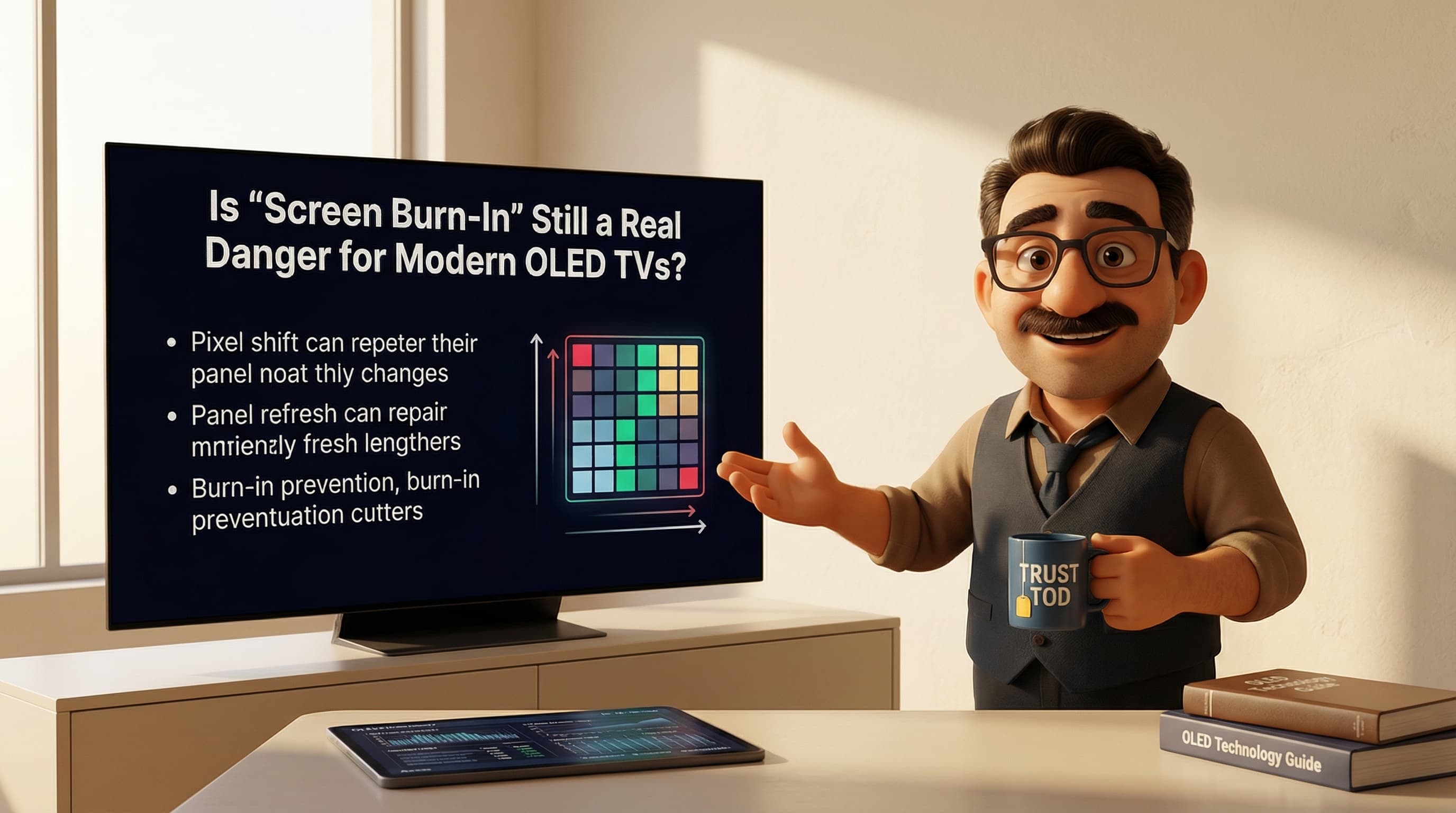
1. Pixel Shifting (The Musical Chairs Method) This is delightfully simple but incredibly effective. Every few minutes, the TV will subtly shift the entire image by a few pixels in a random direction. You won't even notice it happening, but it means that a static logo is never sitting on the exact same cluster of pixels for hours on end. It spreads the workload, stopping any single pixel from getting exhausted.
2. Automatic Brightness Limiting (ABL) & Logo Dimming Modern OLEDs are incredibly smart. They have built-in algorithms that actively scan the screen for static, high-contrast elements—like a Sky Sports 'bug' or a gaming scoreboard. When the TV spots one, it locally reduces the brightness of just those specific pixels. By dimming the logo slightly, it massively slows down the degradation of those organic compounds.
3. Hardware Upgrades: Heatsinks and W-OLED/QD-OLED Heat is the absolute enemy of organic compounds. The hotter a pixel gets, the faster it ages. Premium modern OLEDs now feature physical heatsinks layered behind the panel to draw heat away from the pixels. We've also seen brilliant advancements in sub-pixel layouts, like adding a white sub-pixel (W-OLED) to take the strain off the red, green, and blue ones, or using Quantum Dots (QD-OLED) to boost brightness without overworking the panel.
4. The Invisible Night-Shift: Compensation Cycles This is the big one. When you put a modern OLED into standby mode after a few hours of watching, it doesn't just go to sleep. It runs maintenance cycles. The TV measures the voltage and electrical resistance of every single pixel to check for uneven wear. If it spots that some pixels are getting tired, it invisibly adjusts the voltage supplied to them, ensuring completely uniform brightness across the entire panel the next time you turn it on.
The Great Wall-Plug Mistake
Now, this brings me to a crucial point, and it’s a uniquely British problem. We love switching things off at the wall. My dear old nan used to unplug the toaster, the microwave, and the telly every single night to save electricity and stop the house from burning down.
If you buy an OLED TV, you must never turn it off at the mains socket.
Remember those clever invisible compensation cycles I just mentioned? They only run when the TV is in standby mode. If you kill the power at the wall, the TV cannot perform its nightly pixel maintenance. Over time, this is the quickest way to guarantee you do get screen burn. Leave it on standby, folks. The few pennies it costs in electricity are worth saving a two-grand television.
Temporary Image Retention vs. Permanent Burn-in
Let’s go back to my mate Dave. What he experienced wasn't burn-in; it was Temporary Image Retention.
If you have a bright, static image on screen for twenty minutes and then switch to a solid dark grey background, you might see a faint ghost of the previous image. This is just the panel holding a residual electrical charge. It is entirely temporary and will vanish completely after a few minutes of normal viewing or after the TV runs its next standby cycle. Don't panic! LED TVs (including QLEDs) are completely immune to this OLED-style burn-in, but remember they are prone to their own failures like dead backlight zones or dirty screen effect.
The Verdict: Should You Still Worry?
So, is screen burn-in still a real danger for modern OLED TVs?
Yes, but with a massive, blinking caveat. It is no longer an inevitability; it is an extreme edge case.
If you are buying a TV for a pub, or an airport lounge, and you plan to leave BBC News 24 running on maximum brightness for 14 hours a day, 365 days a year—do not buy an OLED. You will eventually degrade the pixels unevenly.
But for a standard UK household? For a family that watches a bit of Netflix, catches the football on a Saturday, plays a few hours of PlayStation in the evening, and watches terrestrial telly? The risk is statistically negligible. Those recent accelerated lifespan tests by RTINGS have shown that it takes thousands of hours of continuous, extreme, static content to cause noticeable damage on a modern panel.
To keep your OLED looking pristine for a decade, just follow my simple golden rules:
- Leave the safeguards on (Logo Dimming, Pixel Shifting).
- Use a screensaver if you leave Spotify or a paused game on the screen.
- Keep the screen out of harsh, direct, prolonged sunlight (UV rays accelerate degradation).
- And for the love of all things holy, leave it on standby at the wall!
Finally, if you’re still feeling a bit twitchy, look at your warranty options. Standard 1-year guarantees usually don't cover burn-in as it's considered "wear and tear." But premium brands like LG now offer 5-year guarantees on their high-end models that do cover it. Furthermore, brilliant UK retailers like John Lewis (with their Protect Plus) and Richer Sounds offer extended guarantees that specifically protect against permanent screen burn. It’s worth checking out for absolute peace of mind.
The bottom line? OLED TVs offer the most breathtaking, cinematic picture quality available today. Don't let an outdated myth from 2013 rob you of a brilliant movie night.
Still not sure which television is right for your living room? Blimey, there's a lot of choice out there. Come and have a chat with me over at tod.ai. I’ll ask you a few quick questions about what you like to watch, and I’ll help you find the absolute perfect telly for your space and budget. Cheers!
Related reading: