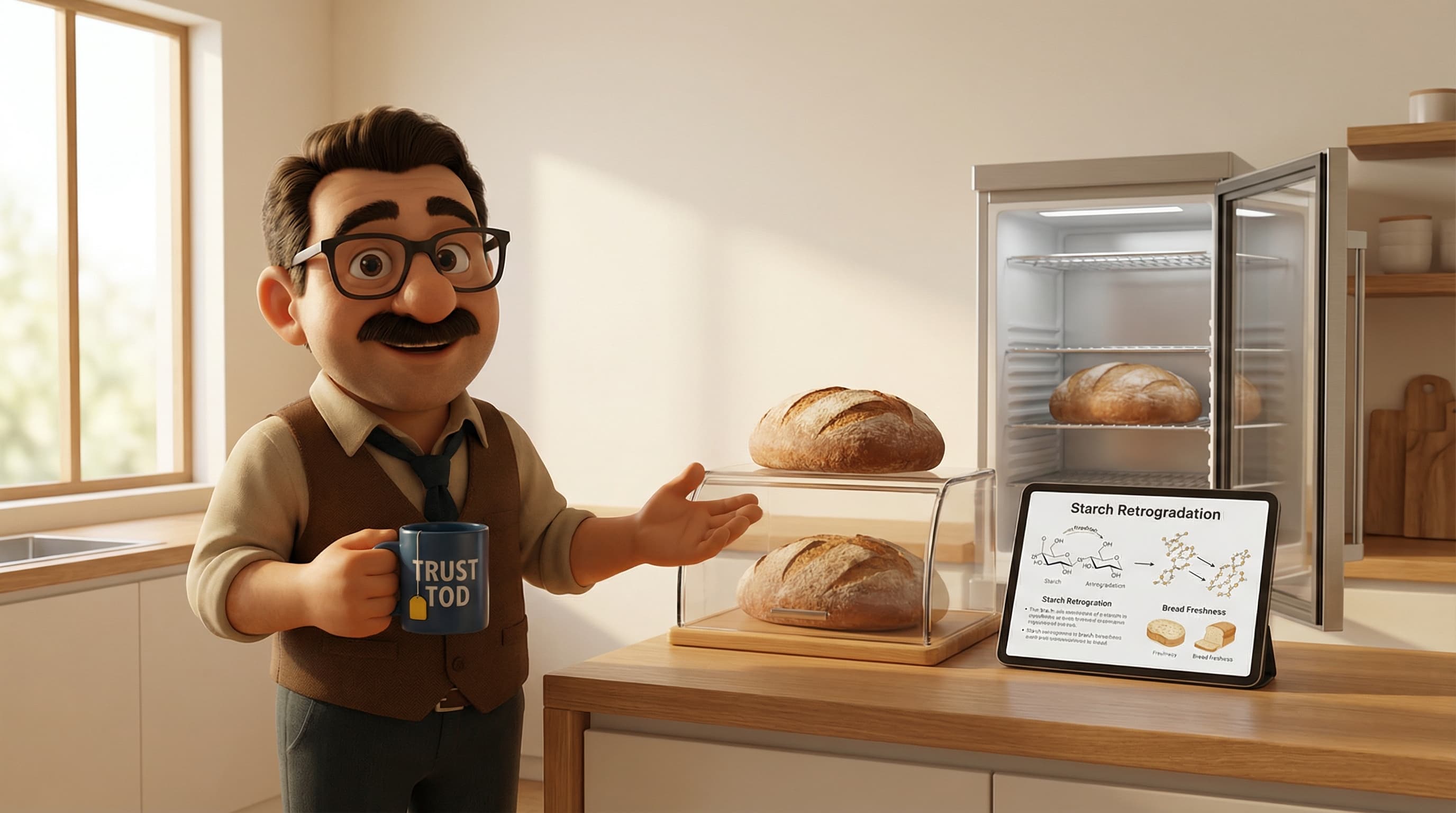
The Great Bread Debate: To Chill or Not to Chill?
Right, pop the kettle on and pull up a chair. We need to have a serious chat about what’s going on in your kitchen.
Picture the scene: It’s a rainy Saturday morning—proper grim weather outside—and all you want is a comforting round of hot buttered toast with your builder’s tea. You reach for the loaf, but instead of heading to a bread bin, your hand drifts towards the fridge door. You pull out a bag of sliced white that feels cold, stiff, and frankly, a bit sad. You toast it, but the texture is all wrong. It’s gritty. It’s dry. It’s a culinary tragedy.
I’ve seen it time and again while helping folks sort out their kitchen tech at tod.ai. There is a silent epidemic in British kitchens: the habit of storing bread in the fridge.
It sounds sensible, doesn’t it? We put the milk, the cheese, and the leftover Shepherd’s Pie in there to stop them going off. Surely, the fridge is a magical box that pauses time for all food? Well, I’m afraid I have to be the bearer of bad news. When it comes to your loaf, the fridge is actually a freshness vampire.
Let’s dive into the science, the history, and the solution to this age-old debate. And don’t worry, I won’t get too boggy with the technical jargon—I’ll keep it digestible, unlike that refrigerated slice of sourdough.
The Myth: The "Safe Zone" Logic
Why do we do it? Why do millions of us insist on shoving a perfectly good loaf next to the mayonnaise?
It largely comes down to intuition. In the kitchen, we operate on a simple binary: Cold equals Fresh; Warm equals Rot. We know that bacteria love room temperature, and we know that mould is the enemy of bread. If you’ve ever reached for a slice only to find a fuzzy green colony has set up shop on the crust, you know the heartbreak. It’s enough to put you off sandwiches for a week.
So, the logic follows: if the fridge stops the milk from turning sour, it must stop the bread from going mouldy. And to be fair, you aren’t entirely wrong. The cold environment of a refrigerator does slow down the growth of mould spores. If your only goal in life is to have a loaf of bread that is technically free of fungus for three weeks, the fridge is your friend.
However, we don’t eat bread just because it lacks mould. We eat it because it’s soft, springy, and delicious. And this is where the fridge betrays you. It trades mould-free existence for a texture that resembles cardboard.
The History: When Grandma Was Right
Now, before we judge, we have to look at where this habit came from. It’s not just nonsense; it’s historical behaviour passed down through generations.
Cast your mind back—or ask your nan—about kitchens in the 1950s and 60s. Central heating wasn’t standard. British homes were often damp, drafty places. In those conditions, a loaf of bread left in a ceramic crock or a tin bin was a sitting duck for mould. The moisture in the air was a killer.
Furthermore, the bread itself was different. This was before the mass adoption of the Chorleywood Bread Process—that’s the high-speed mixing method invented in the UK in the early 60s that gave us the super-soft, preservative-laden sliced loaves we see today (think Warburtons or Hovis). Back then, bread had fewer preservatives. It went off quickly.
When domestic fridges started becoming common household appliances, they were seen as miracle machines. Pop the bread in there, and suddenly it didn't turn green overnight. People were willing to sacrifice a bit of texture to stop the spoilage. But we’ve kept the habit long after our homes became drier and our bread recipes changed. We’re using a 1950s solution for a modern problem.
The Truth: A Lesson in Chemistry (Keep with me!)
Here is the technical bit, but I promise it’s fascinating. The reason bread goes stale in the fridge isn't because it "dries out" in the traditional sense of losing water. It’s down to a process called starch retrogradation.
Let’s break it down:
- The Baking: Wheat flour is packed with starch granules. When you bake bread, you add water and heat. The starch granules absorb that water, swell up, and lose their rigid crystal structure. They turn into a disorganized, gelatinized goo. That’s what makes fresh bread soft and fluffy.
- The Cooling: The moment the loaf leaves the oven, those starch molecules start getting homesick. They want to go back to their original, rigid, crystalline state. As they slowly realign and recrystallize, they push the water molecules out of the structure.
- The Staling: This recrystallization turns the soft crumb hard and brittle. That is staling.
Here is the kicker: This process happens fastest at temperatures just above freezing.
Scientific studies have shown that bread stored at typical fridge temperatures (around 3°C to 5°C) stales roughly six times faster than bread stored at room temperature (around 20°C).
By putting your loaf in the fridge, you are essentially hitting the "fast-forward" button on the aging process. You might stop the mould, but you’re guaranteeing that the bread will be tough, gritty, and unpleasant within a day. Even if the plastic bag keeps the moisture inside the wrapper, the moisture has left the starch, meaning the texture is ruined.
The Modern Reality: Sourdough vs. The Supermarket Slice
It is worth noting that not all bread is created equal, and this affects how badly the fridge treats them.
The Supermarket Loaf: If you are buying standard sliced white or wholemeal from the supermarket, it’s loaded with emulsifiers and preservatives (like calcium propionate). These are clever little chemical additives designed specifically to interfere with that crystallization process I mentioned. They fight retrogradation. This is why a loaf of Kingsmill can sit on your counter for five days and still feel squishy. Because of these preservatives, you really don’t need the fridge to stop mould—the bread is engineered to survive at room temperature.
The Artisan Loaf: If you’ve treated yourself to a lovely sourdough or a crusty bloom from a local bakery, the fridge is a death sentence. These loaves rely on natural hydration and lack those high-tech preservatives. If you put a fresh sourdough in the fridge, it will be rock hard by the next morning. It’s a waste of good dough!
Rye Bread Exception: There is always one exception to the rule, isn't there? 100% Rye bread has a different chemical structure and actually resists staling quite well. It can handle the cold better than wheat bread, but honestly, it’s still happier in a dark cupboard.
Common Misconceptions to Avoid
While we are busting myths, let’s tackle a few other "kitchen crimes" I see often:
- "The Top of the Fridge is a Good Spot": Blimey, please don’t do this. I know it saves counter space, but think about how a fridge works. It pumps heat out to keep the inside cold. The coils on the back (or the vents on older models) release warm air that rises. By putting your bread bin on top of the fridge, you are heating it up, creating a warm, cozy incubator for mould. It’s the worst of both worlds.
- "Plastic Bags Keep Crusts Crispy": They certainly do not. Plastic traps moisture. If you buy a crusty baguette and wrap it in plastic, the crust will go soft and chewy within hours. Crusty bread needs a paper bag or a bread bin with a little airflow.
The Verdict: Tod’s Action Plan
So, if the fridge is the enemy, how do we keep our toast top-tier? Here is my definitive guide to bread storage:
1. The Bread Bin is Best (Short Term)
For the bread you are going to eat within 2 to 4 days, a traditional bread bin is king. It provides a cool, dark environment that balances humidity. It stops the bread sweating (mould) but keeps enough air out to stop it drying. Room temperature—around 20°C—is the sweet spot where retrogradation is slow.
2. The Freezer is the Hero (Long Term)
This is the secret weapon. While the fridge (cool) accelerates staling, the freezer (sub-zero) stops it dead.
At temperatures below -18°C, the water molecules freeze instantly before they can migrate out of the starch. The process is paused.
- The Strategy: As soon as you buy a loaf, slice it (if it isn't already). Keep half out for the next two days, and put the other half immediately into the freezer.
- The Revival: You can toast bread straight from frozen. The intense heat of the toaster re-gelatinizes the starch, essentially "resetting" the bread to a fresh state. It’s brilliant. If you have a whole loaf frozen, let it thaw at room temperature—never in the fridge!
3. The "Refresh" Trick
If you have a loaf that has gone a bit stale on the counter, don't bin it. Splash it with a tiny bit of water and pop it in a hot oven for 5 minutes. The heat and moisture will reverse the crystallization temporarily, giving you one last chance to enjoy it warm.
Final Thoughts
Technology is wonderful. I spend my days analysing the best smart appliances, from washing machines to AI-driven ovens. But sometimes, the best "tech" tip is simply understanding the chemistry of your food.
So, do yourself a favour: liberate your loaf from the chiller. Buy a nice bread bin, make friends with your freezer, and enjoy toast the way it was meant to be—crunchy on the outside, soft in the middle, and absolutely nowhere near the mayonnaise.
Looking to upgrade your kitchen setup? whether you need a freezer spacious enough for all your sourdough or a toaster with a dedicated 'defrost' setting, I can help you find the perfect match.
👉 Chat with me today at tod.ai for personalised tech recommendations!
Related reading: