The Guilt of the 'Ping': Are We Nuking Our Nutrition?
Picture the scene: It’s a rainy Tuesday evening in November. You’ve just walked through the door, soaked to the bone, and the thought of spending forty-five minutes wrestling with pots and pans is about as appealing as a lukewarm cup of tea. You spot a leftover container of Sunday’s roast or perhaps a trusty jacket potato waiting on the counter.
Your hand hovers over the microwave door. You pop the food inside, set the timer for two minutes, and hit start. But as the turntable spins and the machine hums its familiar tune, a little voice in the back of your head whispers, “You know you’re killing that food, right? It’s just going to be empty calories. Dead food.”
We’ve all been there. There is a persistent, nagging guilt associated with the microwave oven. Despite being a staple in British kitchens since the late 70s, many of us still treat it with a level of suspicion usually reserved for unlabelled leftovers found at the back of the fridge.
But here’s the thing—I’m chuffed to tell you that this guilt is largely misplaced. Grab a cuppa, pull up a chair, and let’s have a proper natter about what actually happens inside that metal box. Is the microwave really the villain of the kitchen, or is it the unsung hero of healthy eating?
The Myth: The 'R' Word and The Fear of the Nuke
Let’s address the elephant in the room immediately, shall we? The word "radiation."
If you grew up during the Cold War era, like many of us did, that word carries some serious baggage. It conjures up images of Geiger counters, hazard suits, and glowing green goo. So, when people hear that microwaves use "electromagnetic radiation" to cook food, it’s understandable that they get a bit twitchy.
The myth goes something like this: The violent waves inside the microwave "nuke" the food, scrambling its DNA, obliterating vitamins, and turning your healthy broccoli into a radioactive husk devoid of nutritional value. Some darker corners of the internet—and perhaps a few well-meaning aunties—will even tell you it changes the chemical structure of the food into something unrecognizable to the human body.
Blimey, if that were true, I’d have tossed my microwave in the bin years ago. But the science tells a very different, and much less scary, story.
A Bit of History: Where Did It All Go Wrong?
To understand why we fear the ping, we have to look back at where the fear started. In the early days, specifically around the late 80s and early 90s, there was a fair bit of scaremongering. A Swiss food scientist named Hans Hertel published a small study claiming microwaved food caused changes in the blood indicative of early-stage cancer. Now, keep in mind, this study involved only eight people and wasn't exactly what we’d call rigorous science today, but the tabloids had a field day.
Furthermore, let’s be honest—early microwaves were a bit like sledgehammers. They had one setting: Obliterate. You put a plate of peas in, and 30 seconds later you had bullets. They cooked unevenly, creating "hot spots" that scorched food while leaving other bits stone cold. This led people to believe that the cooking process was unnatural and harsh.
It didn't help that we didn't know how to use them. We tried to cook everything in them, from full Sunday roasts to eggs (an explosive mistake many of us only make once). When you overcook a vegetable until it’s a grey, withered mess, you have destroyed the nutrients. But that wasn't the microwave's fault; it was user error.
The Truth: The Three Enemies of Nutrition
Right, let’s get technical for a moment—but I promise to keep it painless. To understand if microwaves destroy nutrients, we need to know what actually kills vitamins. It’s not "radiation." It’s the unholy trinity of cooking enemies:
- Heat
- Water
- Time
Every time you cook food, regardless of the method, you are breaking down chemical bonds. That’s what cooking is. But some methods are far gentler than others.
The Great British Boiling Problem
Let’s look at the traditional British method of cooking vegetables: Boiling. You take a lovely head of broccoli, toss it in a large pot of water, and boil it for ten minutes until it’s soft.
Scientifically speaking, this is a disaster for nutrition. Vitamin C and B vitamins are water-soluble. When you submerge veg in hot water, those vitamins leach out of the plant cells and dissolve into the liquid. Unless you’re planning to drink that cooking water (and let’s be honest, nobody is drinking broccoli water), you are pouring up to 50% of the nutrients straight down the sink. You’re essentially eating the fibre and throwing away the medicine.
How Microwaves Actually Work
Microwaves work via dielectric heating. The energy waves pass through the food and agitate water molecules, causing them to vibrate rapidly. This vibration creates friction, which creates heat. That’s it. It’s not nuclear fission; it’s just molecular dancing.
Because this process is incredibly fast and requires practically no water, the microwave is actually a nutrient-preservation machine.
- Time: You’re cooking that broccoli in 3 minutes instead of 10.
- Water: You’re using a tablespoon of water, not a litre.
- Heat: The internal temperature rarely exceeds 100°C (the boiling point of the water inside the food), unlike roasting or frying which hits much higher temps.
Studies, including those from the Journal of Agricultural and Food Chemistry, have shown that microwaving retains nearly as much Vitamin C as steaming—which is the gold standard—and significantly more than boiling. In fact, for certain vegetables like spinach, the microwave might even be the king of the kitchen because it cooks so instantly that the nutrients don't have time to break down.
Modern Tech: It's Not the 1980s Anymore
If you’re still using a microwave from 1995 that rattles the whole kitchen counter, it might be time for an upgrade—not just for aesthetics, but for the food quality.
Technology has come a long way. Many modern units, like the ones from Panasonic or Sage that we often chat about on tod.ai, use something called Inverter Technology.
Old microwaves couldn't actually lower their power. If you set them to 50% power, they would just blast at 100% for ten seconds, then turn off for ten seconds, then blast again. This "blast and wait" method is what caused those exploding bean textures.
Inverter microwaves provide a steady stream of power at lower levels. If you ask for 50% power, it gives you a gentle, continuous 50%. This cooks food evenly and gently, preserving the texture and the delicate phytonutrients that can be damaged by intense heat spikes. It’s the difference between gently warming your hands by a fire and sticking them directly into the flames.
The Real Villain: Plastics
I feel it’s my duty to mention the one area where you do need to be careful. The danger isn’t the microwave waves; it’s the container.
There is a misconception that microwaving plastic releases dioxins. While dioxins specifically are rare, it is true that heating non-microwave-safe plastics can cause plasticisers (like BPA or phthalates) to migrate into your food, especially if the food is fatty (like that cheese on your lasagna).
Never microwave margarine tubs, takeaway containers, or random plastic bowls. Stick to glass (Pyrex is brilliant), ceramics, or plastics clearly stamped with the "Microwave Safe" symbol. If you do that, you’re safe as houses.
The Verdict: Tod’s Take
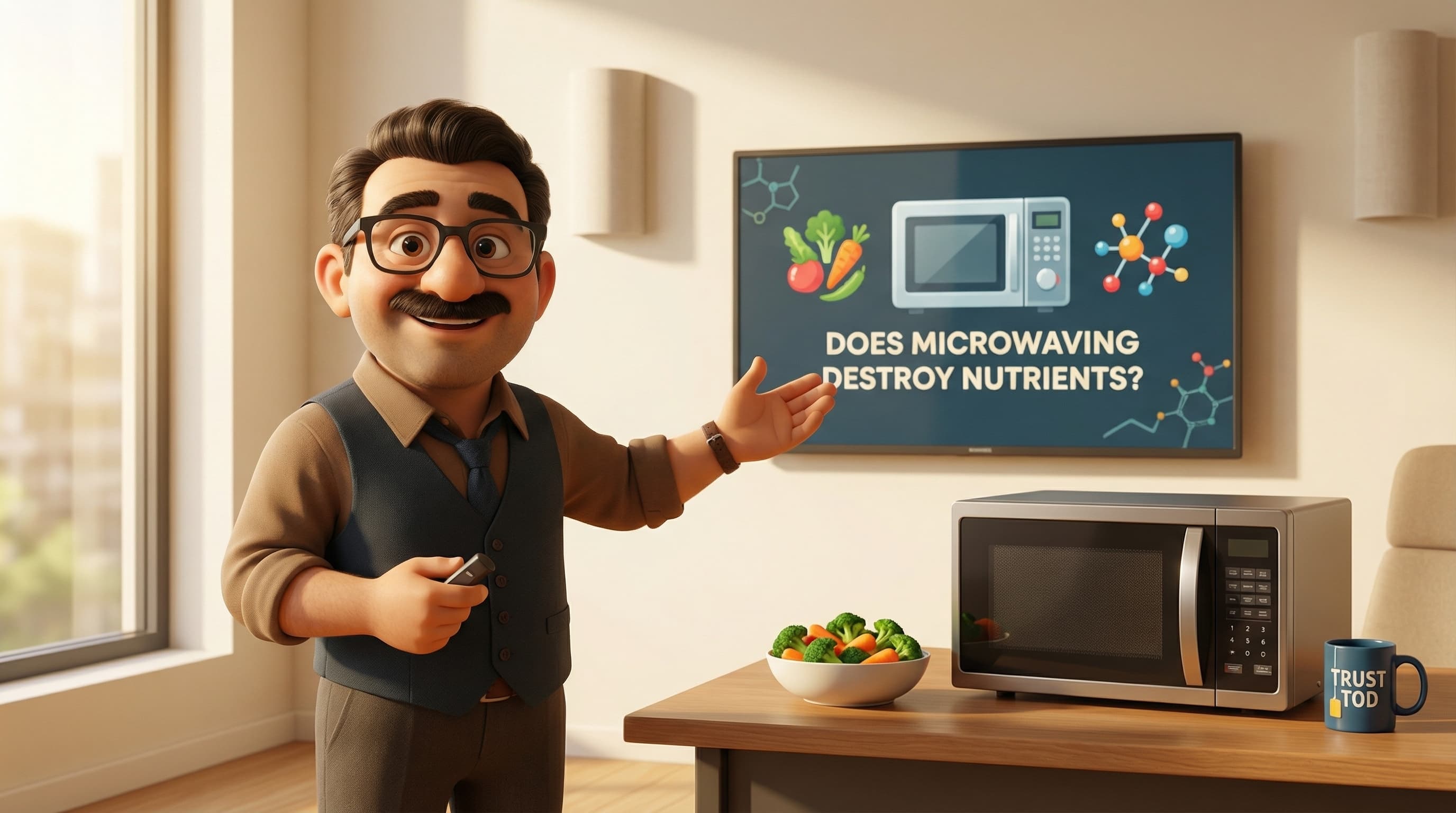
So, does microwaving destroy all the nutrients? Absolutely not.
In fact, compared to the way many of us cook on the hob, the microwave is likely saving your nutrients. It cooks quickly, uses minimal water, and keeps the temperature controlled. It preserves the Vitamin C in your peppers and the antioxidants in your carrots better than boiling ever could.
The only thing the microwave destroys is the time you spend standing over a hot stove.
Here is my top tip for the perfect microwave veg:
- Chop your veg into even pieces.
- Place them in a glass bowl.
- Add one tablespoon of water.
- Cover with a plate (to trap the steam).
- Microwave on high for 2-3 minutes until just tender.
You’ve essentially created a high-speed steamer. It’s quick, it’s healthy, and it leaves you more time to enjoy your evening—perhaps with that cuppa I mentioned earlier.
Don't let the fear of the "ping" put you off. Embrace the technology. If you’re looking for a new microwave that uses that clever Inverter technology to treat your food with a bit more respect, or just want to find the perfect kitchen gadgets to suit your lifestyle, pop over and have a chat with me.
Find your perfect kitchen match at tod.ai.
Related reading: