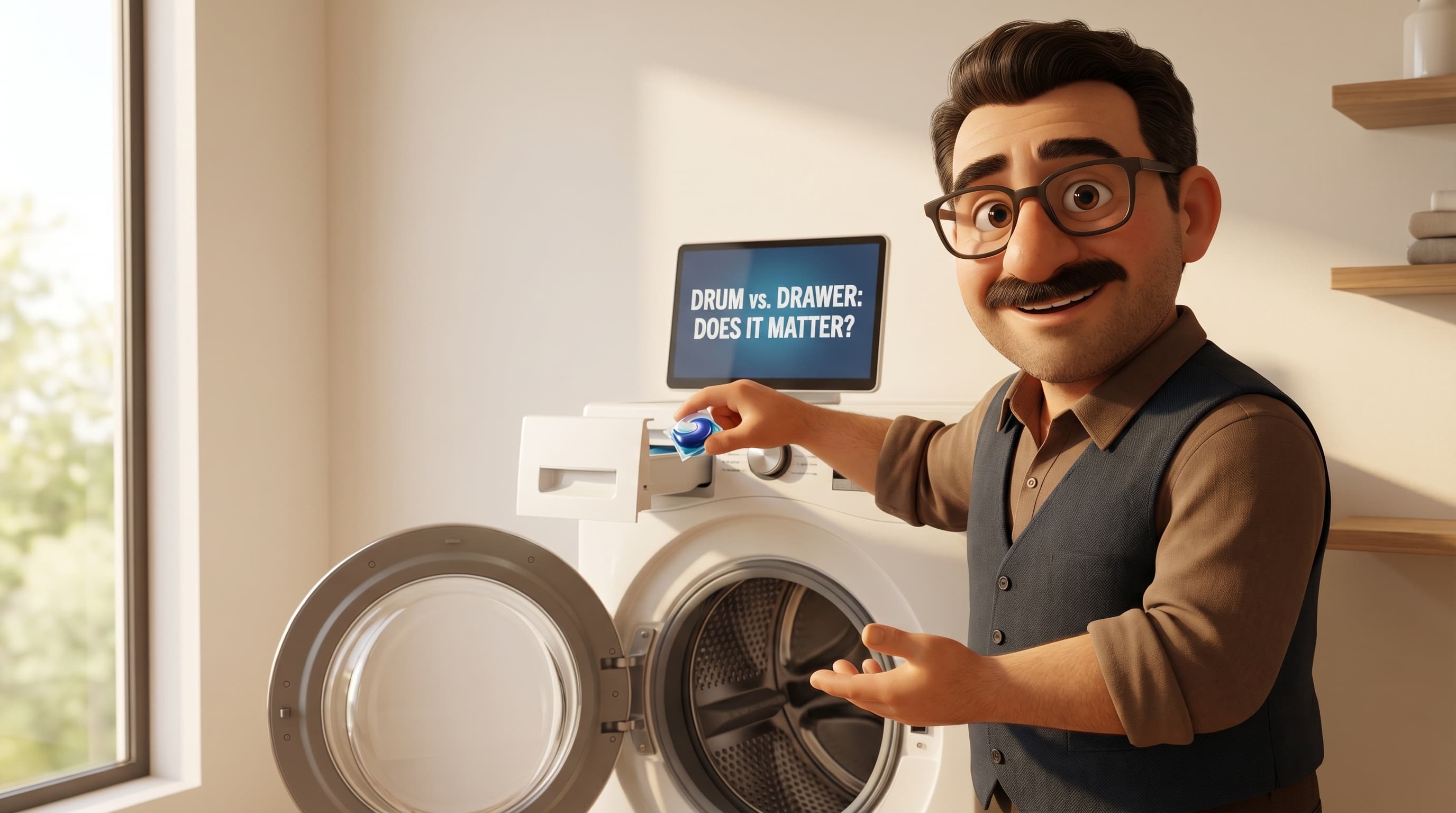
The Great British Laundry Debate: Drum or Drawer?
Right then, put the kettle on, grab yourself a digestive (or a hobnob if you're feeling fancy), and let's have a proper natter. Today, we are going to tackle a household debate that has caused more arguments in British kitchens than how to properly pronounce the word "scone".
Just last week, my mate Dave rang me up in a right state. "Tod," he says, panic clear in his voice, "my washing machine is foaming at the mouth like a rabid dog, and there is a puddle of soapy water making a break for the kitchen hallway."
I popped round, fully expecting a blown pump or a cracked seal. But when I pulled open his washing machine dispenser drawer, I spotted the culprit immediately. Sitting there, looking like a melted alien lifeform, was the sludgy, gelatinous remains of a washing pod. Dave had tossed it into the main wash compartment, assuming the machine would just "sort it out".
Blimey. If I had a quid for every time I've seen this exact scenario, I'd be sunning myself in Barbados by now. It turns out, Dave isn't alone. Millions of us across the UK are making this same fundamental laundry error every single week.
So, does it actually matter if a washing pod goes in the drum or the drawer? The short answer is: yes, it absolutely matters. But to understand why, we need to take a little trip down memory lane and look at the history of our beloved British white goods.
The Myth: "Detergent is Detergent, Right?"
To understand where this belief comes from, we have to look at our ingrained consumer habits. We are creatures of routine, especially when it comes to chores.
The myth is brilliantly simple, and honestly, quite logical if you don't know the mechanics of a washing machine. The thinking goes like this: the drawer has a little compartment with a "II" symbol on it. That symbol means "main wash". A washing pod is for the main wash. Therefore, the pod goes in the drawer. It's A to B to C.
For decades, the golden rule of laundry was that the machine's dispenser drawer was the absolute "control centre" for all chemicals. You put your pre-wash powder in compartment I, your main wash powder or liquid in compartment II, and your lovely, sweet-smelling fabric softener in the little section with the flower symbol. You shut the drawer, pressed start, and let the machine do its magic. Why on earth would a pod be any different?
A Brief History of the Soap Dispenser
To truly grasp why this myth persists, we need to rewind a bit. Back in the 1960s and 1970s, the UK saw a massive shift from manual twin-tub machines to the glorious modern convenience of the automatic front-loading washing machine.
These machines were revolutionary. They were designed to automatically flush water through specific compartments at exactly the right point in the cycle. The drawer was meticulously engineered to handle loose, free-flowing materials. The water would cascade into the drawer, sweep up the powder or liquid, and carry it down a narrow rubber hose—known as the dispenser pipe—straight into the drum.
Then, the early 2000s rolled around. The laundry landscape changed forever when brands like Ariel and Persil introduced "liquitabs" to the UK market. These early washing pods were a marvel of convenience—no more messy measuring cups, no more spilled powder on the linoleum.
But here is where the problem started. When these pods hit supermarket shelves, many of us simply applied our existing laundry logic to the new product. We assumed that all detergent, regardless of its physical form, belonged in the drawer. The drawer was the detergent portal, and old habits die hard.
The Science Bit: Why the Drawer is a Recipe for Disaster
Now, let's get into the nitty-gritty. I promise I won't get too technical, but understanding the science behind modern washing pods is crucial to understanding why Dave's kitchen looked like an Ibiza foam party.
Washing pods are not just blobs of soap; they are highly concentrated cleaning agents encased in a fascinating water-soluble polymer film called Polyvinyl Alcohol (often abbreviated as PVA or PVOH). This film is a brilliant piece of chemical engineering, but to dissolve completely and release the detergent, it demands three very specific conditions:
- Sufficient Water Volume: The polymer chains need a substantial amount of water to break down properly.
- Mechanical Agitation: It needs the physical tumbling action of the clothes to bash it about and break the softened casing apart.
- Time: It needs prolonged exposure to water throughout the main wash cycle.
When you place a pod in the dispenser drawer, you are depriving it of all three of these essential elements.
The water flow in a standard UK front-loader's drawer is relatively gentle. It's designed to wash away loose powder, not to dissolve solid plastics. If you put a pod in there, the water flow is simply not voluminous or forceful enough. Worse still, there is absolutely zero mechanical agitation in the drawer.
So, what actually happens? The casing absorbs a small amount of the water passing through. Instead of dissolving cleanly, it turns into a thick, sticky, gelatinous sludge. This sludge bursts prematurely and oozes down into the narrow dispenser pipe. Because it hasn't dissolved, it sticks to the sides of the pipe.
Over time—or sometimes instantly—this creates a massive blockage. The machine tries to pump more water into the drawer, but the pipe is clogged with PVA sludge. The water has nowhere to go but out the front of the drawer, running down the front of the machine and all over your floor. Meanwhile, your clothes are tumbling around in the drum with nothing but plain tap water, meaning you're getting an absolutely rubbish wash.
UK appliance engineers and major manufacturers like Bosch, Beko, and Hotpoint are unequivocally clear on this: pods in the drawer are a fast track to blockages and breakdown callouts.
Modern Realities: Eco Washes and Low Temperatures
You might be thinking, "Well, I've done it once or twice and it was fine." But modern technology has actually made proper pod placement more critical than ever.
Modern UK washing machines are incredibly water-efficient, designed to meet strict energy and environmental standards. They use a fraction of the water that machines used twenty years ago. Because there is less water splashing about, the pod needs to be in the absolute optimal position to dissolve.
Furthermore, as a nation, we've had a massive (and highly commendable) shift toward low-temperature washing. Washing at 20°C or 30°C is brilliant for saving on energy bills and protecting the environment. However, cold water slows down the dissolution of the PVA film. If the pod isn't sitting in the deepest pool of water with maximum agitation, the film simply won't break down entirely. This is how you end up with those annoying, sticky, blue-green residue streaks on your favourite jumper.
Common Fails: The "Top of the Pile" and Quick Wash Traps
Even when folks realise the drawer is a no-go zone, they often still get the drum placement wrong. Let's look at a couple of common pitfalls.
The "Top of the Pile" Error: Many people load all their dirty laundry into the drum, and then toss the pod right on top of the pile before slamming the door. This is a massive mistake. When the cycle starts, the initial spin action frequently flings the lightweight pod forward. It ends up getting trapped in the rubber door seal (the bellows) right against the glass.
Sitting in the seal, it barely gets wet and doesn't get agitated by the clothes. It just slowly melts against the glass door, leaving a messy streak, and completely failing to clean the load behind it.
The Quick Wash Trap: We all love a 15- or 30-minute rapid eco-cycle when we're in a rush. But pods are generally a terrible choice for ultra-short, cold cycles. The PVA film simply does not have enough time to completely dissolve. If you are doing a rapid wash, you are much better off using liquid or powder detergent, which disperses instantly.
Hard Water and Mould: The Drawer's Dark Secrets
There are a couple of related myths I hear all the time that I want to clear up.
First up: "I live in London, we've got hard water, so I have to put the pod in the drawer to mix with the water first."
Nonsense. In hard water areas (like London and much of the South East), limescale is a genuine headache, but it doesn't change the physics of a PVA pod. Hard water simply means you might need to use two pods for heavily soiled or particularly large loads (anything over 7kg). But both of those pods still need to go straight into the drum.
Second: "The machine will clean the drawer out anyway, so it doesn't matter."
Oh, if only that were true! The sticky residue from a ruptured pod, combined with old fabric softener, creates an absolute breeding ground for black mould. This is a notoriously common problem in British washing machines. Pull your drawer completely out and look at the roof of the compartment housing—if you've been putting pods in there, I guarantee you'll find a nasty, black, fuzzy surprise waiting for you. It smells damp, it ruins your clothes, and it's thoroughly unhygienic.
The Verdict: Tod's Foolproof Guide to Perfect Laundry
So, there we have it. The idea that a pod can go in either the drum or the drawer is entirely false. Putting a pod in the dispenser drawer is technically incorrect, potentially damaging to your machine, and will result in poorly washed clothes.
If you want to get the absolute best out of your appliance and your detergent, here is the definitive, foolproof best practice for using a washing pod in a front-loading machine:
- Empty the Machine First: Always start with a completely empty drum.
- Pod at the Back: Place the pod directly at the back of the empty drum. This ensures it will be submerged in the deepest pool of water as the machine fills, and prevents it from being thrown forward into the rubber door seal.
- Load on Top: Pile your dirty laundry into the drum on top of the pod. The weight of the clothes keeps the pod trapped at the back where the mechanical agitation and water flow are at their strongest.
It's a simple little tweak to your routine, but I promise you, it will save your machine from blockages, save your clothes from sticky residues, and keep your kitchen floor nice and dry.
I'm absolutely chuffed to be able to help you get the most out of your home tech. Taking care of your appliances doesn't require a degree in engineering—just a bit of know-how and a willingness to break old habits.
If you're ever in doubt about how to treat your tech, or if you're on the hunt for a new washing machine that can handle your family's monumental laundry piles, come and have a chat with me over at tod.ai. I'm always here to point you in the right direction, no jargon, no fuss—just proper, honest advice.
Right, I think that kettle's boiled. Time for that cuppa!
Related reading: