The Glaring Red Light of Doom
Picture the scene. You've just finished a lovely Sunday roast, the plates are scraped, and you're loading them into the dishwasher. You're looking forward to putting your feet up with a well-earned cuppa, watching the telly, and letting the machine do the hard graft. You shut the door, press 'Start', and there it is. That little red 'S' symbol, or perhaps a two-curved-arrow icon, blinking away on the digital display. It's glaring at you like a disappointed headteacher.
The dishwasher salt warning light.
If you're anything like most Brits, you probably let out a small sigh, rummage under the kitchen sink, and drag out a massive, heavy box of dishwasher salt. You then engage in the awkward contortionist routine of unscrewing that tricky cap at the bottom of the machine, trying to pour the massive grains into the tiny hole without spilling them everywhere, and invariably ending up with salty water all over your hands.
But what if I told you that depending on where you live in the UK, you might be doing all this faffing about for absolutely nothing?
I'm Tod, your friendly neighbourhood tech expert, and today we're going to have a proper natter about one of the most persistent domestic myths in Britain: the idea that every dishwasher, regardless of where it is, desperately needs dishwasher salt to survive.
The Myth: "No Salt Means a Broken Machine"
The belief that a dishwasher strictly requires salt is practically baked into our national consciousness. It’s an inherited wisdom, passed down from parents to children, and enthusiastically repeated by appliance salespeople up and down the high street.
We’re told that failing to top up the salt reservoir will instantly ruin the machine's internal plumbing, leave our best wine glasses looking like they've been dragged through a muddy puddle, and generally lead to a costly breakdown. That persistent red warning light only reinforces the panic. After all, if the machine is flashing a warning at you, it must mean something terrible is about to happen, right?
Well, as with many tech myths, this one is rooted in a grain of truth—but it's a truth that belongs to a bygone era.
A Trip Down Memory Lane: Why We Started Using Salt
To understand where this belief came from, we need to hop into the time machine and travel back to the 1980s and 1990s.
When dishwashers first became a mainstream, must-have appliance in UK kitchens, the technology was, quite frankly, a bit basic. The detergents of the day were simple powders that didn't contain any built-in water-softening agents. More importantly, the early dishwashers didn't feature adjustable water hardness settings. They were a 'one size fits all' bit of kit.
Now, here's the rub: over 60% of the UK suffers from hard to very hard water. If you live in London, the South East, or East Anglia, your tap water has percolated through chalk and limestone, picking up massive amounts of calcium and magnesium along the way.
When this hard water is heated inside an appliance, it creates limescale. Left unchecked, limescale is an absolute menace. It can easily clog a dishwasher's heating element and spray arms, leading to disastrous breakdowns.
Because appliance manufacturers sold the exact same machines to households in hard-water London and soft-water Glasgow, writing instruction manuals that blanket-prescribed the use of dishwasher salt was the easiest way to prevent hard-water damage and massive waves of warranty claims. It was a classic "better safe than sorry" bodge job. Over the decades, it became utterly ingrained in the British domestic routine that salt was simply a non-negotiable part of running a dishwasher.
The Science Bit: How Dishwasher Salt Actually Works
To understand why you might not need salt, it really helps to know what the salt actually does. And prepare to be gobsmacked: dishwasher salt never actually touches your dishes.
Many folks believe the salt is thrown around the wash chamber to physically scrub the baked-on beans off their plates, or that it mixes directly with the detergent. Not true!
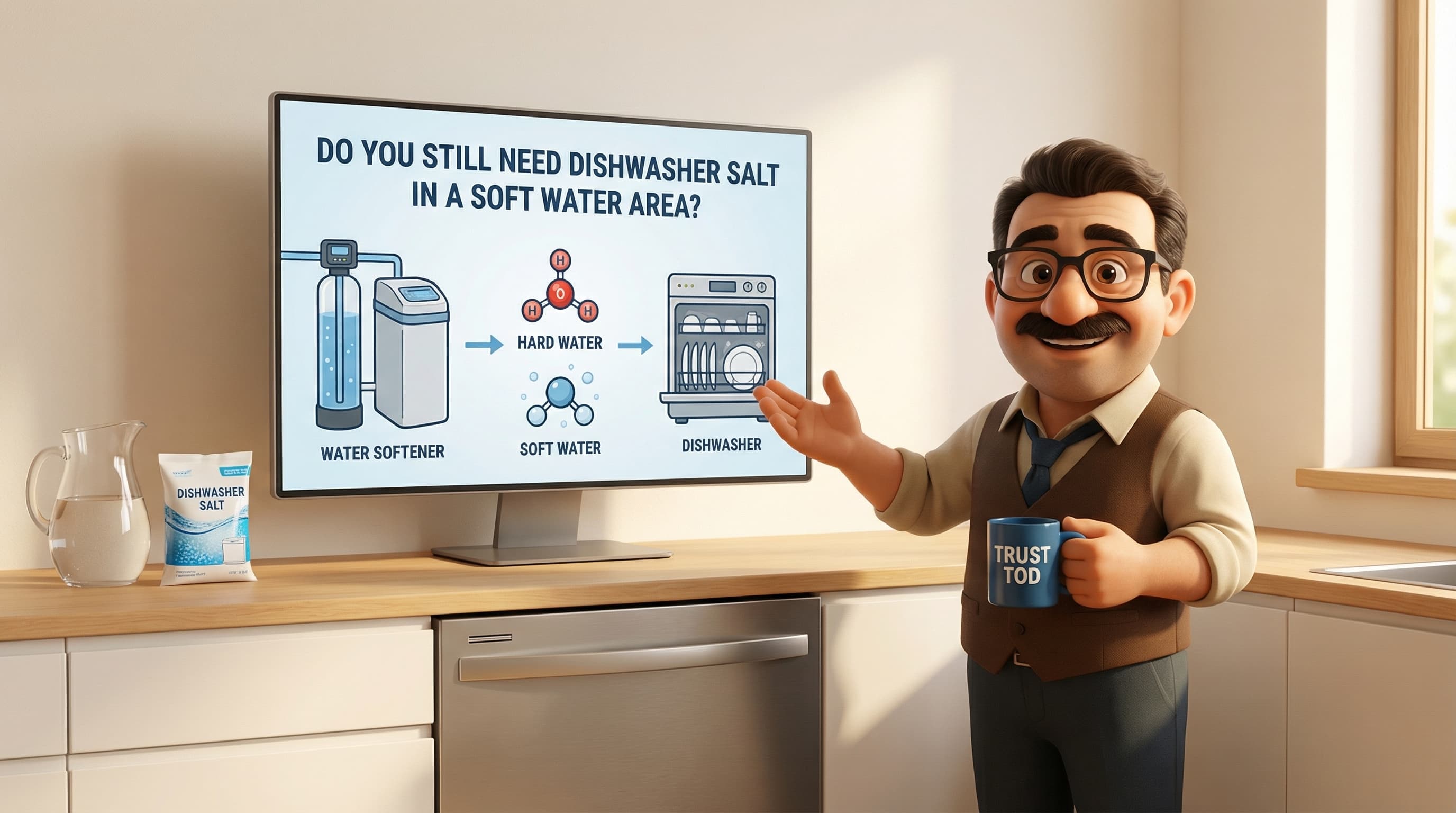
The salt sits in a hidden chamber at the very bottom of the machine. This chamber contains something called an "ion-exchange resin." Think of this resin like a massive, incredibly strict bouncer at the door of an exclusive nightclub.
When hard tap water tries to enter the washing chamber of the machine, it must first pass through this resin. The resin "bouncer" grabs hold of the rowdy calcium and magnesium ions (the troublemakers that cause limescale) and kicks them out, replacing them with well-behaved sodium ions.
Over time, however, our poor bouncer gets completely overwhelmed by the amount of calcium he's holding onto. He needs to be refreshed, or "regenerated." This is where your dishwasher salt comes in. The machine takes the salt, turns it into a highly concentrated brine, and flushes it through the resin. This super-salty wash forces the calcium off the resin and washes it straight down the drain, leaving the bouncer ready for another shift.
But here is the absolute clincher: if your water naturally lacks calcium and magnesium—meaning you live in a soft water area—the resin has absolutely nothing to filter out. It’s a bouncer standing outside an empty pub. Therefore, the resin never gets clogged, and it never needs to be regenerated with salt.
The Modern Reality: Tablets and Smart Machines
Since the days of basic powders and "dumb" machines, two major technological leaps have completely changed the game.
Firstly, modern dishwashers are incredibly clever. They now feature programmable water hardness settings. By checking your local water hardness, you can actually program the dishwasher’s computer, telling it exactly how much salt to use—if any.
Secondly, we saw the invention of "All-in-One" or "Multi-Action" dishwasher tablets. These brilliant little blocks contain powerful chemical water softeners (like polycarboxylates). If you live in an area with mild to moderate water hardness, these modern tablets can easily handle the water softening all by themselves, without the machine's dedicated salt unit needing to lift a finger.
So, what does this mean for you? Well, it depends on your postcode. According to the UK water boards, areas with soft water (less than 100 parts per million of calcium carbonate) include Scotland, Wales, Cornwall, Devon, and much of North West England. If you're living in Manchester, you're blessed with beautifully soft water piped in right from the Lake District via United Utilities.
If you live in Edinburgh, Cardiff, or Manchester, pouring salt into your dishwasher is literally pouring money down the drain.
Busting the Big Salt Misconceptions
Before we wrap up, let's quickly put to bed a few of the most common—and sometimes damaging—misconceptions I hear on a daily basis.
Misconception 1: Cloudy glasses mean you need MORE salt. Blimey, this is a big one, and getting it wrong will ruin your best glassware! If you live in a soft water area and your glasses are coming out looking milky or cloudy, adding salt will make it worse. This cloudiness is often a phenomenon known as "glass corrosion." Soft water, when combined with harsh, modern dishwasher detergents and high washing temperatures, can permanently etch the silicates in glass. It’s not limescale; it’s actual physical scratching that cannot be washed off. If you have soft water and cloudy glasses, you are over-softening the water. Stop using salt immediately and lower your wash temperature!
Misconception 2: You can use regular table salt in a pinch. Please, I'm begging you, never do this. Table salt, cooking salt, and sea salt contain anti-caking agents to stop them clumping up in the shaker. If you put these into your dishwasher, those anti-caking agents will permanently clog and completely ruin the ion-exchange resin. Proper dishwasher salt is 100% pure sodium chloride, specially formed into large, chunky granules designed to dissolve slowly.
Misconception 3: If the red light is on, the machine won't work properly. The red "S" light is what we in the tech trade call a "dumb sensor." It only knows one thing: whether the physical reservoir is empty or full. It has absolutely no idea what the chemical makeup of your local water supply is. Ignoring the light (or better yet, properly disabling it via the machine's settings) in a soft water area will not harm the machine's performance or lifespan in any way whatsoever.
The Verdict: What Should You Do Now?
Right, let's get you sorted. Here is Tod’s foolproof, step-by-step guide to mastering your dishwasher salt situation:
- Check your postcode: Grab your phone or laptop, go to your local water supplier's website (like Scottish Water, United Utilities, or Thames Water), and type in your postcode. Look for your exact water hardness in parts per million (ppm) or Clark degrees.
- Factor in your detergent: If you live in a moderately hard water area but use premium "All-in-One" tablets (like Finish Quantum or Fairy Platinum), check the packaging. Most explicitly state they are effective in water up to 21°dH, which covers the vast majority of the UK.
- Program your machine: Dig out your dishwasher’s manual. If it’s currently propping up a wobbly table in the shed, don't panic—just search your model number online. Find the section on "Water Hardness Settings."
- Turn it off: If you live in a soft water area, or rely on premium tablets in a moderate area, use the button combination to set the hardness level to "0" or "Level 1".
By doing this, you tell the machine to stop drawing salt. But the best part? It will permanently turn off that annoying red 'refill salt' warning light.
For millions of households across the UK, buying dishwasher salt is nothing more than an inherited habit that provides absolutely zero benefit. By taking five minutes to look up your local water hardness and program your machine, you can save yourself a few quid at the supermarket, stop the glaring red light of doom, and protect your glassware from permanent soft-water etching. I'd say that's a result to be chuffed about!
Looking for more straight-talking, jargon-free advice to help you find the perfect appliances and tech for your home? Pop over to tod.ai and let's have a chat. Whether you need a dishwasher that handles London limescale or a washing machine that fits snugly under your counter, I'm here to help you make the right choice, stress-free.
Related reading: