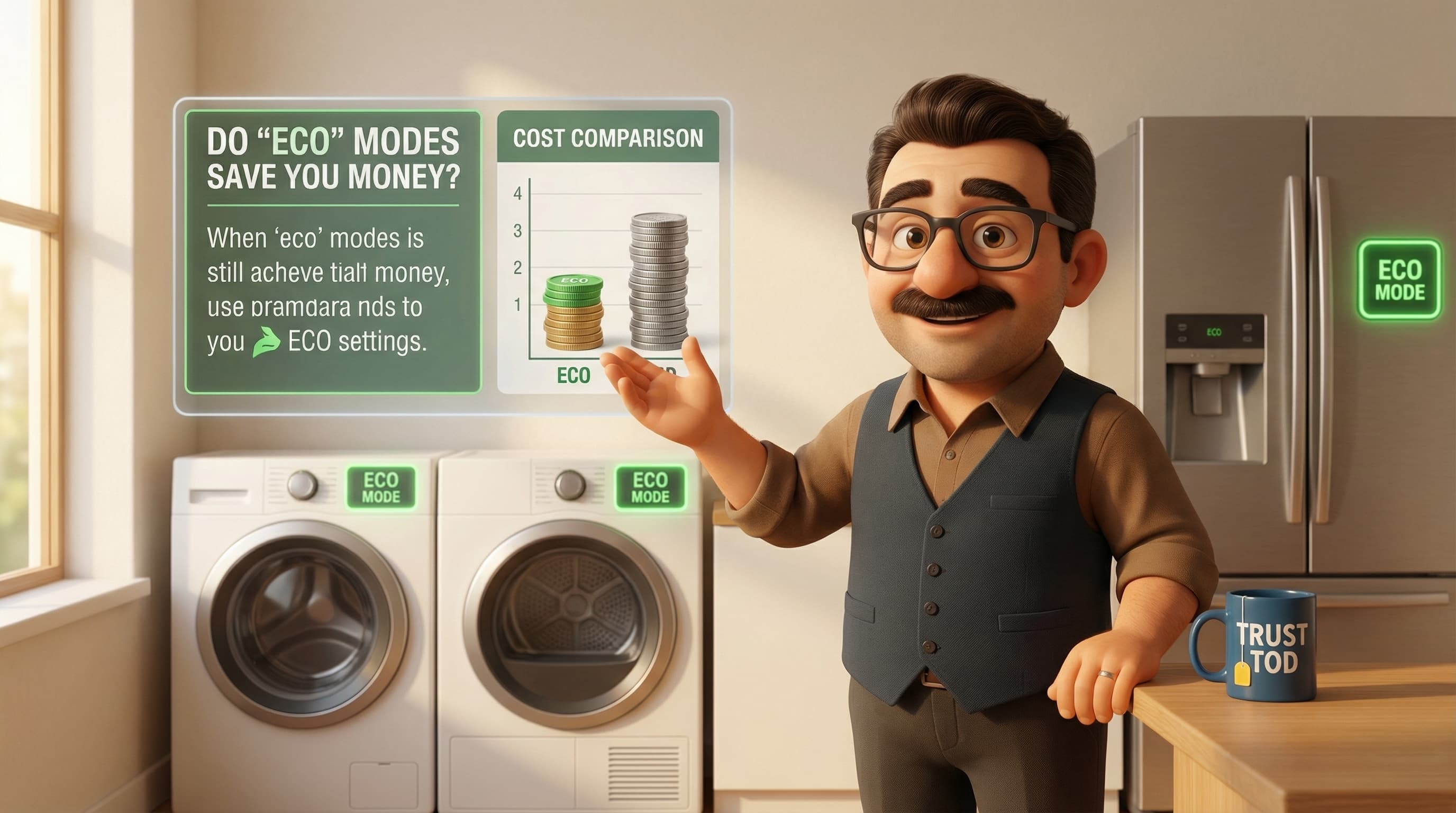
The Great Kitchen Standoff: Why Time Doesn't Equal Money
Picture the scene. It’s Tuesday evening, you’ve just finished a lovely shepherd's pie, and you’re loading the dishwasher. You pop the tablet in the slot, close the door, and your finger hovers over the buttons. You glance at the 'Eco' setting. You’re tempted—you want to do your bit for the planet, and frankly, with the energy prices looking a bit scary these days, you want to save a few bob.
But then you see it.
The display flashes up: 3:40.
Three hours and forty minutes? Blimey! You instinctively recoil. "I'm not leaving it on for nearly four hours!" you mutter to yourself. "That’ll cost a fortune in electricity!" So, you slide your finger over to the 'Quick' or 'Daily' cycle. It’s done in 60 minutes. You feel efficient. You feel like you’ve just outsmarted the energy company.
I hate to be the bearer of bad news, but you’ve actually just done the appliance equivalent of sprinting to the shops to buy a pint of milk when a leisurely walk would have been free.
Hello there! I’m Tod, and welcome back to the blog. Today we’re going to have a proper natter about one of the most persistent myths in the UK household: the idea that a longer cycle means a higher energy bill. Grab a cuppa (go on, you’ve got time while the machine’s running), and let’s dive into why your intuition is playing tricks on you.
The Myth: The Lightbulb Logic
To understand why we all fear the long cycle, we have to look at how we’ve been trained to think about electricity. For decades, our understanding of energy consumption has been based on what I call "The Lightbulb Logic."
It’s simple maths, isn’t it? If you leave a 60-watt lightbulb on for one hour, it uses X amount of energy. If you leave it on for four hours, it uses 4X. The same goes for that electric bar heater your gran used to have—leave that on all day and you’d need a second mortgage to pay the bill.
We naturally map this logic onto our white goods. We see the drum spinning or hear the water swooshing, and our brains imagine the electricity meter spinning like a fidget spinner the entire time. We equate duration with consumption.
And to be fair to you, this wasn’t always a myth. Back in the day—let’s say pre-2000s—washing machines were mechanically pretty simple. They were essentially big kettles with a single-speed motor attached. If those old beasts were running for two hours, they were keeping the water hot and the motor chugging at full pelt for two hours. In 1995, a quick wash was cheaper.
But technology has moved on massively, while our intuition is still stuck in the era of dial-up internet and Ceefax.
The Truth: It’s All About the Heat, Not the Beat
To understand why Eco modes work, we need to look at the science of cleaning. In the appliance industry, there’s a concept called the Sinner’s Circle (named after Dr. Herbert Sinner, not a moral judgement on your laundry habits).
Effective cleaning relies on four factors working together:
- Temperature (Heat)
- Mechanical Action (Movement/Scrubbing)
- Chemical Action (Detergent/Enzymes)
- Time
Think of these four things as slices of a pie chart. If you want the pie to remain the same size (i.e., get the same cleaning result), but you want to reduce one slice, you have to make another slice bigger.
Here is the crucial fact that changes everything: Heating water is expensive. Turning a motor is cheap.
In a washing machine or dishwasher, the heating element is the energy vampire. It accounts for roughly 70% to 90% of the total electricity used in a cycle. The motor that spins the drum? It uses peanuts by comparison.
The Soaking Strategy
So, how does 'Eco' mode save money? It ruthlessly cuts down the Temperature slice of the pie (the expensive bit) and compensates by massively increasing the Time slice (the cheap bit).
Think of it like washing a roasting tin after a Sunday roast. You have two options:
- The High Energy Way: Blast it with scalding hot water and scrub it furiously with a wire wool pad for 5 minutes. (This is your standard/intensive cycle).
- The Eco Way: Fill it with lukewarm water and a bit of fairy liquid, and leave it on the side for 4 hours. When you come back, the burnt-on gravy just wipes away.
Option 2 took way longer, but you did almost no work. That is exactly what your dishwasher is doing on Eco mode. It’s soaking your dishes. It’s not spraying hot water constantly for 3 hours; it’s spraying a bit, waiting, spraying a bit more, and letting the enzymes in the tablet do the heavy lifting.
Modern Tech: The Secret Sauce
If you’ve bought a machine in the last 5-10 years—perhaps a Samsung Ecobubble, a Bosch Series 6, or a reliable Hotpoint—it’s packed with clever tech that makes Eco mode even more efficient.
1. Inverter Motors: Old motors were all-or-nothing. Modern brushless inverter motors are like dimmer switches. They can tumble your clothes gently for three hours using a fraction of the power an old motor used in 30 minutes. They are whisper-quiet and incredibly efficient.
2. Fuzzy Logic Sensors: Your machine is smarter than it looks. It actually "tastes" the water (using turbidity sensors) to see how dirty the load is. In Eco mode, it stops heating the water the second it reaches the minimum effective temperature. Older machines would just boil away regardless of whether the water was already hot enough.
Busting the Myths: "But..."
I can hear you shouting at the screen. "But Tod, surely..." Let’s tackle the common objections I hear at tod.ai.
"Quick Wash is surely cheaper because it’s only 30 minutes!"
Ah, the Quick Wash trap. I see this all the time. The 30-minute cycle is the "sports car" mode of laundry. To get your clothes clean in such a short time, the machine has to ramp up the heater immediately to get the water hot fast, and it has to spin the drum aggressively.
It’s like driving from London to Manchester at 100mph because you’re late. You’ll get there faster, but you’ll burn through a tank of petrol. A Quick Wash typically uses more energy than a 3-hour Eco cycle. Keep the Quick Wash for emergencies or lightly soiled gym kit only.
"What on earth is 'Eco 40-60'?"
If you’ve bought a washer since Brexit, you’ve probably seen this setting on the dial. It’s mandatory by law now. This causes so much confusion! People think, "Well, which is it? 40 or 60?"
Here’s the secret: The name "Eco 40-60" refers to the clothes you can put in, not the water temperature. It means you can throw in your 40°C cottons and your 60°C cottons together. The machine will wash them using the most efficient method possible.
Spoiler alert: The water often doesn't even reach 40°C. It might peak at 35°C, but because it washes for longer, it achieves the same cleaning result as a 60°C wash without the energy cost. It’s clever, even if the name is a bit rubbish.
"Eco mode leaves my machine smelling damp."
This is the only valid downside. Because Eco modes run cooler, they don't kill bacteria inside the drum as effectively as a hot wash. If you use Eco exclusively, you might get a bit of mould in the seal or a fusty smell.
The Fix: Use Eco for 95% of your washes. But once a month, run a "Service Wash"—empty drum, hottest setting (usually 90°C), with some powder bleach or machine cleaner. That kills the bugs and keeps the machine sweet.
The Verdict: Trust the Clock (and Your Wallet)
So, what’s the bottom line for your bank account?
According to data from Which? and the Energy Saving Trust, switching from a standard cycle to an Eco cycle saves roughly 30% to 40% in energy.
In real money terms, with the current price cap, if a standard wash costs you 35p, an Eco wash might cost 20p. It doesn't sound like much per wash, does it? But let's say you do 5 washes a week. That’s a saving of around £40 to £60 a year just by turning a dial. That’s a nice meal out or a few months of streaming subscriptions, effectively for free.
My recommendation is simple: Unless you need that favourite shirt for a night out in an hour, always press Eco.
Ignore the "3:40" on the display. It is lying to your intuition. That long duration is the sound of your machine taking its time to soak your clothes clean gently, rather than boiling them clean expensively. You are trading time (which you have plenty of while the machine is on) for energy (which costs you money).
So, go on. Embrace the three-hour cycle. Your clothes will be cleaner, your carbon footprint will be smaller, and your smart meter will stop flashing red quite so often.
Need help finding a machine that makes saving energy easy? Whether you're after a wizard washing machine or a dreamy dishwasher, I can help you sort the wheat from the chaff. Pop over to tod.ai and let's find your perfect match.
Related reading: