Right, Let's Pop the Kettle On...
Right, put the kettle on, grab a biscuit, and make yourself comfortable. We need to have a proper natter about something that's been bugging me lately. As the cost of living has crept up and energy bills have become a regular topic of conversation down the pub, I've noticed a piece of advice floating around everywhere. You've probably seen it too: 'Dust off the slow cooker to save a fortune!'
My mate Dave took this so much to heart that he's started cooking absolutely everything in his. The other day, he proudly served me up a pasta bake that had been stewing since breakfast. Blimey. It was like chewing on warm wallpaper paste. I didn't have the heart to tell him it was rubbish, but as a tech chap, I did have the urge to look at his energy meter.
It got me thinking: is this age-old advice actually true? Are slow cookers always the cheapest way to put a hot meal on the table? Or are we sacrificing the quality of our dinners for a saving that doesn't actually exist? Today, we're going to put on our detective hats and debunk a myth that's been hanging around British kitchens since avocado bathroom suites were in fashion.
The Myth: 'Ditch the Oven, Use the Slow Cooker'
If you have a scroll through social media or read any frugal living blog, the advice is almost universal. The logic, on the surface, seems completely bulletproof. An oven is a massive appliance that gets incredibly hot, so it must guzzle electricity like nobody's business, right? Meanwhile, a slow cooker is a dinky little pot that barely takes up any counter space and gently simmers away. Therefore, the slow cooker must cost mere pennies, whilst turning the oven on requires a small mortgage.
It's this exact line of thinking that leads people to force every single meal into a slow cooker. Quick weeknight chicken breasts, simple fish dishes, and even baking cakes—all shoved into a ceramic pot just to avoid touching the oven dial. People honestly believe that the very act of switching an oven on is a massive financial drain.
But as with most things in the world of home appliances, the reality is a fair bit more nuanced. To understand why we all believe this so passionately, we need to take a little trip back in time.
A Trip Down Memory Lane: The 1970s Energy Crisis
This myth didn't just appear out of thin air; it has very real, very logical roots. Let's wind the clock back to the 1970s. Flares were wide, disco was king, and the UK was right in the middle of a massive energy crisis. It was during this turbulent time that the 'Crock-Pot' and similar slow cookers were introduced to the British market.
They were aggressively marketed as the ultimate money-saving miracle. The adverts promised you could 'cook all day for pennies' and magically transform cheap, boot-leather cuts of meat into tender, mouth-watering stews. And here's the kicker: back then, they were absolutely right!
You see, electric ovens in the 1970s and 80s were notoriously rubbish when it came to efficiency. They lacked the advanced thermal insulation we take for granted today. They leaked heat profusely into the kitchen—which was lovely in winter, but a nightmare for your electricity bill. Because they lost so much heat, the heating elements had to work almost constantly just to maintain the cooking temperature. There were no internal fans to circulate the heat, so everything took ages to cook.
The maths back then was stark. An old, poorly insulated 3,000-watt (3kW) oven roasting a joint of beef for two hours would draw nearly its maximum wattage for the entire duration, guzzling up to 6 kWh of electricity. In contrast, a 150-watt slow cooker bubbling away for 8 hours used just 1.2 kWh. It was a no-brainer. The slow cooker was unequivocally the cheaper option. But tech hasn't stood still, my friends.
The Truth: Modern Ovens are Clever Beasts
Fast forward to the present day, and the appliances in our kitchens are basically spaceships compared to what our mums and grandmums were using. To understand what's actually happening to your smart meter, we need a quick, pain-free lesson in kilowatt-hours (kWh). Don't worry, I promise to keep it simple!
The formula for appliance running costs is straightforward: Appliance Wattage (in kW) multiplied by the Time Used (in hours) equals the Energy Consumed (in kWh).
Currently, under the UK Energy Price Cap (let's use an average of roughly 24.5p per kWh to keep the maths simple), a typical slow cooker uses between 150W and 300W. If you leave a 200W slow cooker on 'Low' while you're at work for 8 hours, it uses about 1.6 kWh. That works out to roughly 39p.
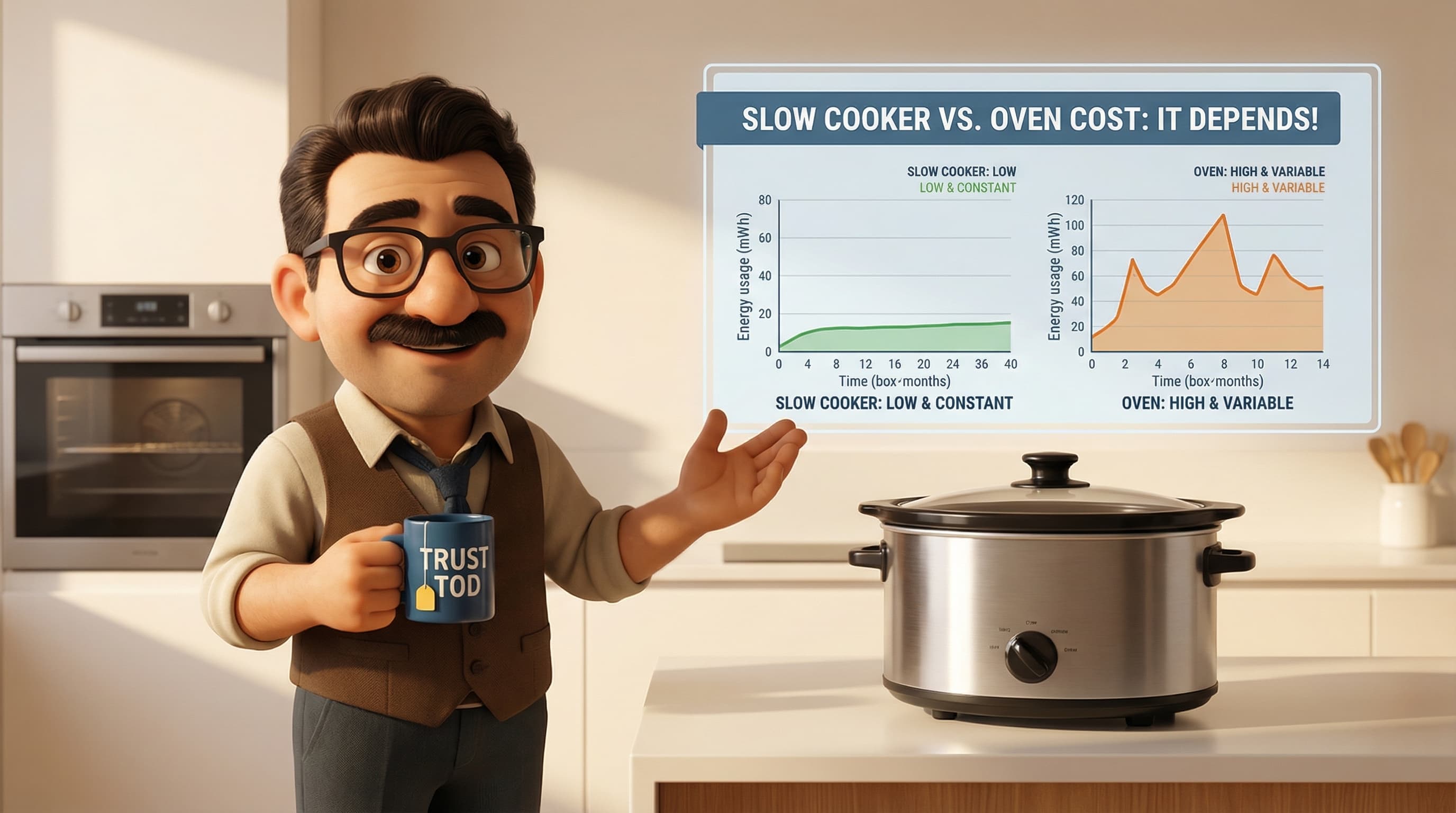
Now, a modern electric oven operates between 2,000W and 3,000W. If you look at that and think 'Blimey, that's ten times more than the slow cooker!' you'd be right. However, and this is the most critical technical fact of the whole article: an oven does not draw this power continuously.
Enter the hero of our story: The Thermostat. Once a modern oven reaches its target temperature (say, 200°C for your chips), the thermostat happily clicks the heating element off. It's having a little rest! It only reignites intermittently to top up the heat. Modern A or A+ rated ovens are marvels of engineering. They feature double or even triple-glazed doors, high-density insulation, and fan-assisted convection technology. That fan circulates the heat, allowing your food to cook up to 25% faster and at temperatures 20°C lower than old conventional settings.
According to the brilliant folks at the Energy Saving Trust, a modern A-rated electric oven uses approximately 0.8 to 0.9 kWh per use. That's about 20p to 22p. Let that sink in for a moment. If you are cooking a meal that takes 45 to 60 minutes in a highly efficient modern oven, it will likely use less electricity than a slow cooker left on all day. The slow cooker costs 39p, the modern fan oven costs 22p. Myth, consider yourself busted.
Common Misconceptions: The Ceramic Sieve
There are a few other misconceptions we need to clear up over our cuppa. First off, people assume slow cookers are highly insulated. Ironically, they're really not. Take a look at yours. It's likely a heavy ceramic crock sitting inside a relatively thin metal casing, topped off with a single-pane glass lid. They actually lose a significant amount of heat to the surrounding room.
Because they lose heat constantly, they have to draw power continuously for those 8 hours. It's a slow, steady trickle of energy, but a trickle over a whole working day really adds up!
Another trap people fall into is thinking the slow cooker is the absolute cheapest appliance in the kitchen. Not quite! While they are economical for the right tasks, microwaves and air fryers frequently beat them hands down in the modern kitchen. A microwave cooking a jacket potato in 8 minutes uses a virtually negligible amount of electricity (around 3p to 5p) compared to a slow cooker doing the same potato over 6 hours. Air fryers are essentially mini, high-powered convection ovens that require zero pre-heating time, making them the thriftiest option for quick, crispy meals.
The Oven's Superpower: Batch Cooking
Before we wrap up, we have to talk about the oven's absolute superpower: space. A slow cooker has a very limited capacity. You can fit one meal in there. A standard oven, however, has multiple shelves.
If you are cooking a massive Sunday roast, you can fit the joint of meat, a tray of crispy roast potatoes, honey-glazed parsnips, a cauliflower cheese, and maybe even an apple crumble in the oven all at exactly the same time. The energy used (let's say 1.5 kWh for a massive, multi-hour cook) divided by the sheer volume of food produced makes the oven incredibly efficient on a 'per portion' basis. You simply cannot replicate this volume in a single slow cooker.
Plus, remember the golden rule of oven efficiency: keep the door shut! Every time you open that door to have a peek at your Yorkshire puddings, you lose up to 25 degrees of heat, forcing the element to draw maximum power to recover. Use the oven light and the glass door to check on your grub.
The Verdict: Tod's Rules of Thumb
So, should you take your slow cooker to the local charity shop? Absolutely not! I'm certainly not saying that. The slow cooker is a magnificent appliance, but it's no longer the undisputed king of cheap cooking. It depends entirely on what you are cooking and how much of it.
For dishes that inherently require long, slow cooking times to break down collagen—like a beautiful beef brisket, rich winter stews, or pulled pork—the slow cooker remains vastly cheaper. Running an oven for 4 hours to slow-roast a brisket will definitely cost you more than running your slow cooker for 8 hours.
Here are my simple rules of thumb to help you keep those energy bills in check:
- The 45-Minute Rule: If a meal takes 30 to 45 minutes to cook (like a pasta bake, fish fillets, or chicken breasts), using the oven or an air fryer is more energy-efficient than leaving a slow cooker bubbling away for 4 to 6 hours. Don't force quick-cook foods into a slow cooker; it's a false economy and results in rubbish textures.
- Embrace the Batch: If you're turning the oven on, make the most of it. Fill those shelves! Cook tomorrow's lunch at the same time as tonight's dinner.
- Right Tool for the Job: Microwaves for quick blasts and jacket potatoes, air fryers for quick crispy bits, ovens for big batch cooks and baking, and slow cookers for tough, cheap cuts of meat.
The idea that the slow cooker is always cheaper is a relic of the 1970s. By understanding how your modern tech actually works, you can cook smarter, eat better, and keep a few extra quid in your pocket.
Speaking of smart tech, if you're ever wondering which appliance is best for your specific kitchen, or you're looking to upgrade to something a bit more energy-efficient, pop over to tod.ai. I'm always there, ready to have a natter and help you find the perfect tech for your home. Stay chuffed, and happy cooking!
Related reading: